AI or Traditional Automation: Which One Does a Business Need?
Automation is not a new concept. Businesses have long used software and integrations to perform repetitive tasks according to predefined rules.
With the rapid adoption of AI, however, a new question increasingly arises: does a process actually need artificial intelligence, or would traditional automation provide a simpler and more predictable solution?
The answer mainly depends on the task.
If a process can be described using clear rules, AI is often unnecessary. If the task involves understanding text, processing variable information or handling situations that are difficult to cover with predefined rules, AI can open up new possibilities.
What is traditional automation?
Traditional automation operates according to predefined rules.
Its logic can often be expressed simply:
If this happens → do that.
For example, a new order in an online store can automatically be transferred to an ERP system. A successful payment can update the order status. Information submitted through a contact form can automatically be added to a CRM.
In these situations, the system does not need to interpret what is happening. The event and the required action can both be clearly defined.
This makes traditional automation highly predictable.
How is AI-powered automation different?
AI can become particularly useful when incoming information is not fully structured or when a task cannot easily be described using simple if/then rules.
An incoming email, for example, does not necessarily follow a predefined format. One customer may request a quote, another may report a technical problem, while someone else may ask about an existing order.
Creating individual rules for every possible wording can be difficult with traditional automation.
An AI-powered system, on the other hand, may be able to interpret the content, classify the message and extract relevant information.
In simplified terms:
Traditional automation: follows predefined rules.
AI-powered automation: can process certain types of variable or less structured information.
When can traditional automation be the better fit?
Using AI does not provide an advantage in every situation.
When a task is clear, repetitive and governed by precise rules, traditional automation is often sufficient.
Examples include:
- transferring data between systems,
- automatically updating order statuses,
- sending invoicing information,
- triggering notifications after predefined events,
- creating records in a CRM,
- synchronising data between applications.
These processes usually do not require a system to interpret the situation.
If an order has a “paid” status, for example, the next action can be defined precisely. A conventional rule or integration can perform the task reliably.
When can AI be useful?
The advantages of AI become more relevant when the task requires some form of interpretation.
- Processing text-based information
Emails, documents, customer messages and other text content do not always follow a consistent structure.
AI can be used to extract certain information, summarise content or classify it.
- Classifying incoming enquiries
A shared inbox may receive many different types of requests.
AI can help determine whether a message relates to sales, customer support or billing, for example, before passing the information to the appropriate workflow.
- Processing documents
When the format or content of documents varies, it can be difficult to cover every possible case with conventional rules.
AI can help extract relevant information from certain documents so that it can subsequently be processed as structured data by other systems.
- Summarising larger amounts of information
Summarising longer documents, customer conversations or other text-based information is another area where AI can support an automated workflow.
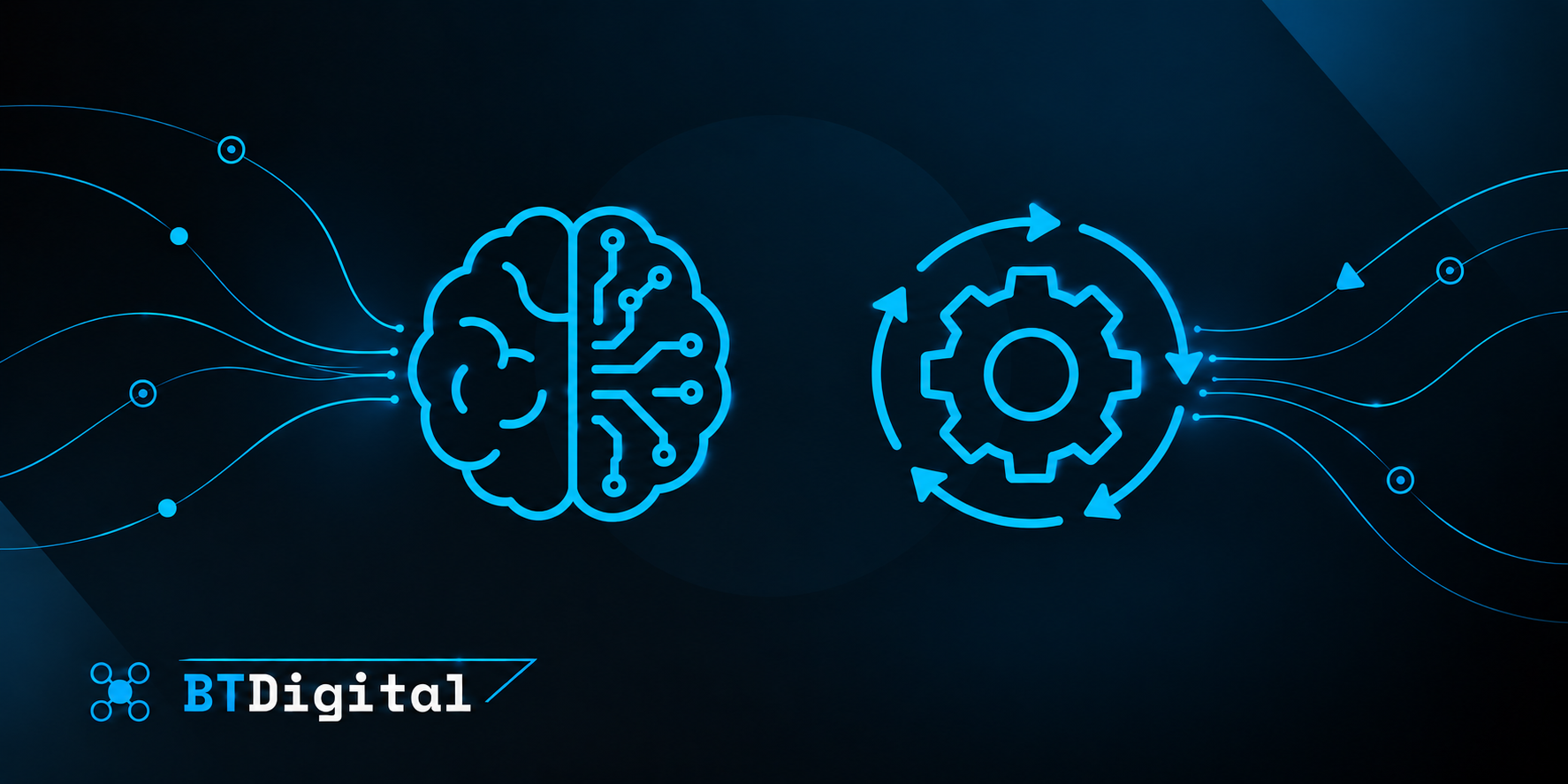
AI and traditional automation do not have to compete
In practice, AI and traditional automation are often not alternatives to each other.
A single workflow can use both.
Consider a business that receives a large number of customer enquiries by email.
AI can analyse the content of each message, identify its topic and extract the relevant information.
Traditional automation can then continue the process using precise rules:
Incoming email → AI interpretation → classification → CRM entry → task creation → notification
In this example, AI handles interpretation, while deterministic automation handles the subsequent actions.
For many business processes, this combination can be particularly practical.
Why not use AI everywhere?
Adding AI does not automatically make a process better.
For a simple data transfer, for example, involving an AI model may introduce unnecessary complexity when the same task can be handled with a few clear rules.
AI-based outputs can also be less deterministic for certain tasks. The same or very similar input may not always guarantee exactly the same output in every situation.
This matters particularly in processes where accuracy, auditability or consistency is essential.
AI should therefore not simply be considered a more modern version of traditional automation. It is a tool suited to a different set of problems.
Where is human decision-making still needed?
Automation does not necessarily mean that a process has to operate entirely without human involvement.
When AI is used, it is particularly important to define which actions can be completed automatically and where human review is required.
A system might, for example, classify a customer enquiry and prepare a draft response automatically, while sending the final response still requires approval.
In other situations, cases below a defined confidence level can be forwarded for manual review.
Designing automation therefore also involves defining the roles of people and software within the process.
How can the right approach be selected?
The starting point should not be identifying where AI can be added.
The business problem should come first.
If the rules of a process can be clearly defined, traditional automation may be sufficient.
If the process requires text interpretation, classification, summarisation or the processing of variable information, AI may be worth considering.
If the workflow contains both types of tasks, the two approaches can be combined.
The appropriate technology should therefore be determined by the problem being solved rather than by the popularity of the technology itself.
The BT Digital approach
BT Digital approaches automation by first understanding the underlying business process rather than starting with a particular technology. The first step is to identify which parts can be described with clear rules, where different systems need to communicate and where AI-based processing can provide meaningful value.
Depending on the workflow, the solution may involve traditional automation, API and system integrations, custom backend logic, AI functionality or a combination of these technologies.
The objective is not to introduce AI simply for the sake of using AI. It is to apply technology that fits the task: avoiding unnecessary complexity where a straightforward rule is enough, while using AI where interpretation can create new opportunities for automation.