How Secure Is Custom Software? 7 Risks Businesses Should Know
Custom business software can offer significant advantages. It can be designed around specific workflows, integrated with existing systems and equipped with functionality that may not be available in off-the-shelf products.
However, flexibility is not the only consideration. Security is equally important.
A customer portal, internal administration platform or custom web application may process sensitive business information, customer records and data essential to everyday operations.
If this information is not adequately protected, a security incident can lead to unauthorised access, data loss or disruption to business activities.
Custom software is not automatically less secure than an off-the-shelf solution.
What matters is how the application is designed, developed, tested and maintained.
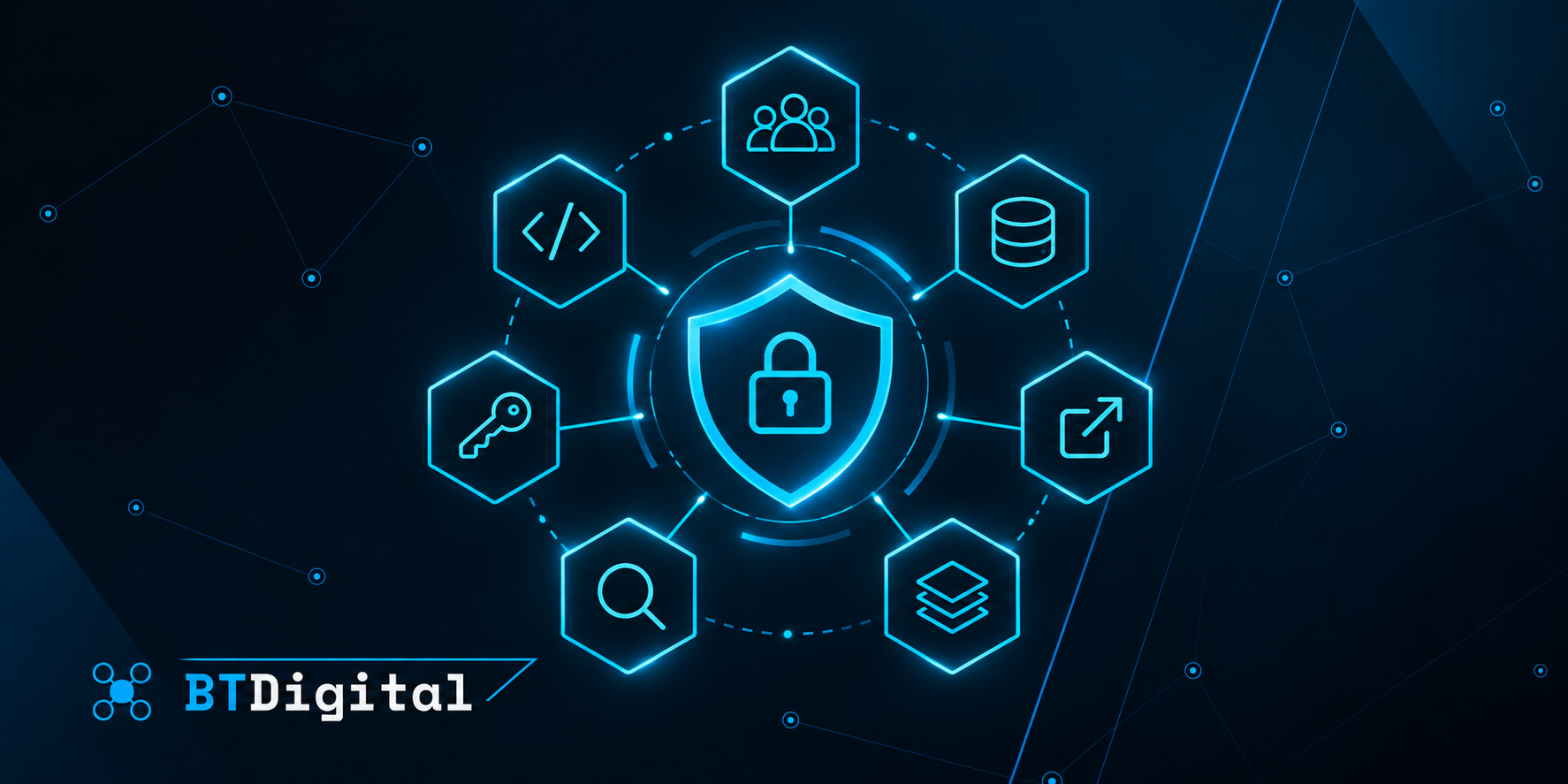
The following seven areas deserve particular attention.
1. Inadequate user permissions
Business applications often have several types of users.
In a customer portal, customers should generally be able to access their own information, while employees may need additional administrative functionality.
In an enterprise management system, sales teams, finance departments and managers may all require different access permissions.
Security risks arise when the application does not properly verify which information and functions each user is authorised to access.
For example, a user might be able to open a document belonging to another customer.
Effective access control involves more than requiring users to log in.
The system must also verify permissions whenever a sensitive operation is performed.
A good approach is to give each user access only to the information and functionality genuinely required for their role.
2. Weak authentication and account protection
Protecting user accounts is one of the most fundamental security requirements.
A custom application needs appropriate mechanisms for handling passwords, login sessions and unauthorised access attempts.
Risks may arise from insecure password handling, poorly protected sessions or accounts that remain active after employees leave the organisation.
For certain systems, multi-factor authentication may also be appropriate.
This requires an additional verification step beyond a password.
It can be particularly important for administrative accounts and applications handling sensitive business information.
Security measures should be selected with both protection and usability in mind.
3. Insufficient protection of business and customer data
For many custom applications, the information they manage is among their most valuable assets.
A system may contain customer records, contracts, financial information, internal documents or operational data.
Protecting this information involves several considerations.
Data should be transmitted over appropriately secured connections, sensitive information should be stored securely and access should be controlled.
Businesses should also consider whether every piece of collected information is actually necessary.
The more sensitive information a system stores, the greater the responsibility involved in protecting it.
When personal data is processed, compliance with applicable data protection requirements, including the GDPR where relevant, must also be considered.
Secure data handling is therefore not a single feature. It is a requirement that influences the design of the entire application.
4. Security vulnerabilities in application functionality
Application security involves more than login protection and database configuration.
Vulnerabilities can also exist within individual features.
For example, an application may fail to validate user input properly or handle uploaded files securely.
Similar issues may occur in search functions, data processing operations or communication with external services.
These problems are not always visible in the user interface.
An application may appear fast, reliable and easy to use while still containing security weaknesses in its underlying functionality.
Development testing should therefore examine not only whether features work correctly, but also how the system responds to unexpected input and unauthorised requests.
Secure development practices, code reviews and targeted security testing can help identify such issues.
5. Risks associated with APIs and external integrations
Modern business applications rarely operate in isolation.
Custom software may connect with CRM platforms, ERP systems, invoicing tools, payment providers and cloud-based services.
These connections are often implemented through APIs.
Integrations can significantly improve business efficiency, but they also introduce additional security considerations.
Communication between systems should be protected, API keys and credentials should be handled securely, and integrations should receive only the permissions they need.
An integration with unnecessarily broad access may create risks that extend across multiple systems.
For this reason, integration security should be considered from the beginning of a project.
Connecting two applications successfully is not enough. Information must also be exchanged in a controlled and secure way.
6. Third-party libraries and software components
Custom software does not mean that every component is built from scratch.
Developers regularly use existing frameworks, libraries and other technical components.
This is standard practice and can offer significant advantages.
However, third-party components can also contain security vulnerabilities.
If an application depends on outdated or unsupported libraries, risks may increase over time.
It is therefore important to understand which components are being used, keep track of their versions and ensure they can be updated when necessary.
Appropriate technology selection and regular reviews can help reduce these risks.
7. Insufficient security testing
Functional testing checks whether an application performs its intended tasks.
For example, it may verify that an order can be created, a search returns the correct results or a report is generated successfully.
Security testing addresses additional questions.
Are user permissions enforced correctly? Can unauthorised users access restricted information? Does the application handle unexpected input safely? Are its APIs adequately protected?
The appropriate level of testing depends on the application's complexity and business importance.
A small internal tool and a high-traffic customer platform processing sensitive information may present very different levels of risk.
For some projects, an independent security assessment or penetration test may be justified.
The essential point is that security verification should be part of the development process rather than an afterthought.
Is custom software more or less secure than off-the-shelf software?
There is no universal answer.
An established software product may benefit from a large user base, regular updates and a dedicated security team.
However, its security still depends on proper configuration, access management and timely updates.
Custom software offers the opportunity to design security requirements around a company's specific operations.
It may support specialised permissions, data handling rules and integration requirements.
These advantages only become meaningful when the application is developed according to appropriate technical and security standards.
Custom development is therefore neither inherently more secure nor inherently less secure.
The quality of implementation and ongoing maintenance is what matters.
How can security risks be reduced from the beginning?
Security should be considered during requirements analysis and system planning.
Businesses should identify which information the application will process, who will use it, what permission levels are required and which external systems it will connect to.
Functions involving sensitive data or business-critical operations should receive particular attention.
This information can guide the design of access controls, data protection measures and security checks.
During development, code reviews, testing and the resolution of identified issues can help reduce risk.
Security should also remain a priority after deployment.
Ongoing updates, permission reviews and responses to newly identified vulnerabilities are important parts of keeping an application secure over time.
The BT Digital approach
BT Digital approaches security as an integral part of custom software development rather than an additional feature to be considered only at the end.
Appropriate system architecture, carefully designed permissions, secure data handling and controlled integrations are important considerations from the planning stage.
When developing custom web and business applications, backend systems, APIs and system integrations, particular attention should be given to how different components communicate and how access to information is controlled.
Security requirements need to reflect the company's operations, the type of information processed and the business importance of the application.
The objective is to create custom software that not only delivers the required functionality but also provides a sound foundation for secure, reliable and sustainable operation.