Business Digital Transformation Step by Step: Where Should You Start?
Digital transformation is no longer relevant only to large enterprises. Small and medium-sized businesses can also benefit significantly from making everyday operations faster, more transparent and less dependent on manual work.
However, digital transformation does not simply mean purchasing new software or replacing paper documents with electronic files.
The real objective is to improve business processes.
Achieving this does not necessarily require replacing every existing system or launching a large IT project at once. In many cases, improving one carefully selected process can already deliver noticeable results.
The most important question is therefore not which technology a business should introduce, but where digital solutions could address genuine operational problems.
What does business digital transformation actually mean?
Digital transformation involves using technology to support, simplify or redesign existing business processes.
This can take many forms.
Paper-based records may be replaced with a central database. Multiple spreadsheets may give way to a shared business application. Repetitive data entry can be automated, while previously disconnected systems can be integrated.
Digital transformation can also help managers access up-to-date reports, allow customers to manage requests online or enable employees to find essential information in one place.
These improvements share a common purpose.
They aim to save time, reduce errors, improve visibility and support business growth.
Step 1: Understand existing business processes
The first step is not choosing software. It is understanding how the business currently operates.
It is worth examining customer management, order processing, invoicing, administration and the flow of information between departments.
Where is the same information entered multiple times? Which tasks require extensive manual effort? Where do errors or delays occur regularly? Which information is difficult to find?
For example, a company may receive customer enquiries by email, prepare quotations in separate documents and track orders in spreadsheets.
This approach may work with a small number of customers, but it can become increasingly difficult to manage as the business grows.
Mapping existing workflows helps identify where the greatest losses occur in time, resources or accuracy.
Step 2: Prioritise the problems worth solving
Not every process needs to be digitalised at the same time.
Introducing too many changes simultaneously can make implementation more difficult and place unnecessary pressure on employees.
A better approach is to identify the areas where improvements could create the greatest business value.
Automating a frequently repeated administrative task, for example, may deliver a faster return than redesigning a rarely used internal feature.
Priorities can be based on the time currently spent on a task, the frequency of errors, the number of employees involved and the expected implementation cost.
A suitable first project is usually clearly defined, commercially justified and measurable.
Step 3: Choose the right digital solution
Once the problem is clear, the available technology options can be evaluated.
Not every business requirement calls for custom development.
An existing CRM platform may be sufficient for customer relationship management, while a ready-made project management tool may help coordinate tasks.
In other situations, business processes may be sufficiently specialised that standard software would require significant compromises.
Custom web applications or internal business systems may then be more appropriate.
Sometimes, the existing applications already provide the necessary functionality but cannot exchange information.
In these cases, system integration may be more effective and cost-efficient than replacing the entire software environment.
The solution should always be selected according to the actual business requirement.
Step 4: Automate repetitive tasks
One of the most visible benefits of digital transformation is the reduction of manual work.
Many businesses spend considerable time copying information, preparing documents, sending notifications and updating records across different systems.
A large proportion of these tasks can be automated.
For example, an online store can automatically transfer order details to an internal management system. Customers can receive notifications when their order status changes, and recurring reports can be generated without manual preparation.
Automation does not necessarily require artificial intelligence.
Well-defined, rule-based processes can often be handled reliably using simpler technologies.
The objective is not to eliminate every human task, but to allow employees to spend less time on repetitive administration and more time on activities that require their attention.
Step 5: Connect disconnected systems
Businesses frequently use several different software applications.
Customer management, invoicing, inventory, online sales and internal administration may all rely on separate systems.
When these applications cannot communicate, employees may need to enter the same information in several places.
This slows down operations and increases the risk of mistakes.
System integration allows information to move between applications in a controlled and reliable way.
For example, new customer information may automatically appear in the CRM, invoicing platform and relevant internal applications.
These connections are often implemented using APIs, which allow software systems to exchange information.
Well-designed integrations can reduce duplicated administration and provide a more accurate view of business operations.
Step 6: Make business data accessible and useful
Digital transformation is not only about completing tasks faster.
It can also help businesses access and understand the information generated by their operations.
When data is spread across spreadsheets, emails and disconnected applications, obtaining an accurate overview can be difficult.
A well-designed digital environment can make information easier to manage consistently.
This may improve order tracking, customer activity analysis and the measurement of operational performance.
Managers may particularly benefit from dashboards and reports displaying important business indicators.
However, information creates value only when it is accurate, up to date and interpreted correctly.
Data quality and consistent record management should therefore be part of the digital transformation process.
Step 7: Involve employees in the change
Introducing a digital solution is not purely a technical project.
Its success also depends on whether employees understand and adopt the new way of working.
When a new application changes everyday tasks, the people affected should understand why the change is being introduced.
Employees who know the existing processes well can provide particularly valuable input.
They may identify practical difficulties that are not immediately visible during management-level planning.
Training, clear instructions and support after implementation can help make the new system part of everyday operations.
Even technically successful software may fail to deliver the expected benefits if employees continue relying on previous manual methods.
Step 8: Measure results and plan further improvements
The effectiveness of digital transformation should be evaluated using concrete business indicators.
A company might measure how long it takes to process an order, how many manual data entry steps have been eliminated or how frequently administrative errors occur.
Collecting these measurements before implementation makes it easier to assess the impact of the improvement.
Digital transformation is not necessarily a one-time project.
As a business grows, new requirements emerge and existing processes can be improved further.
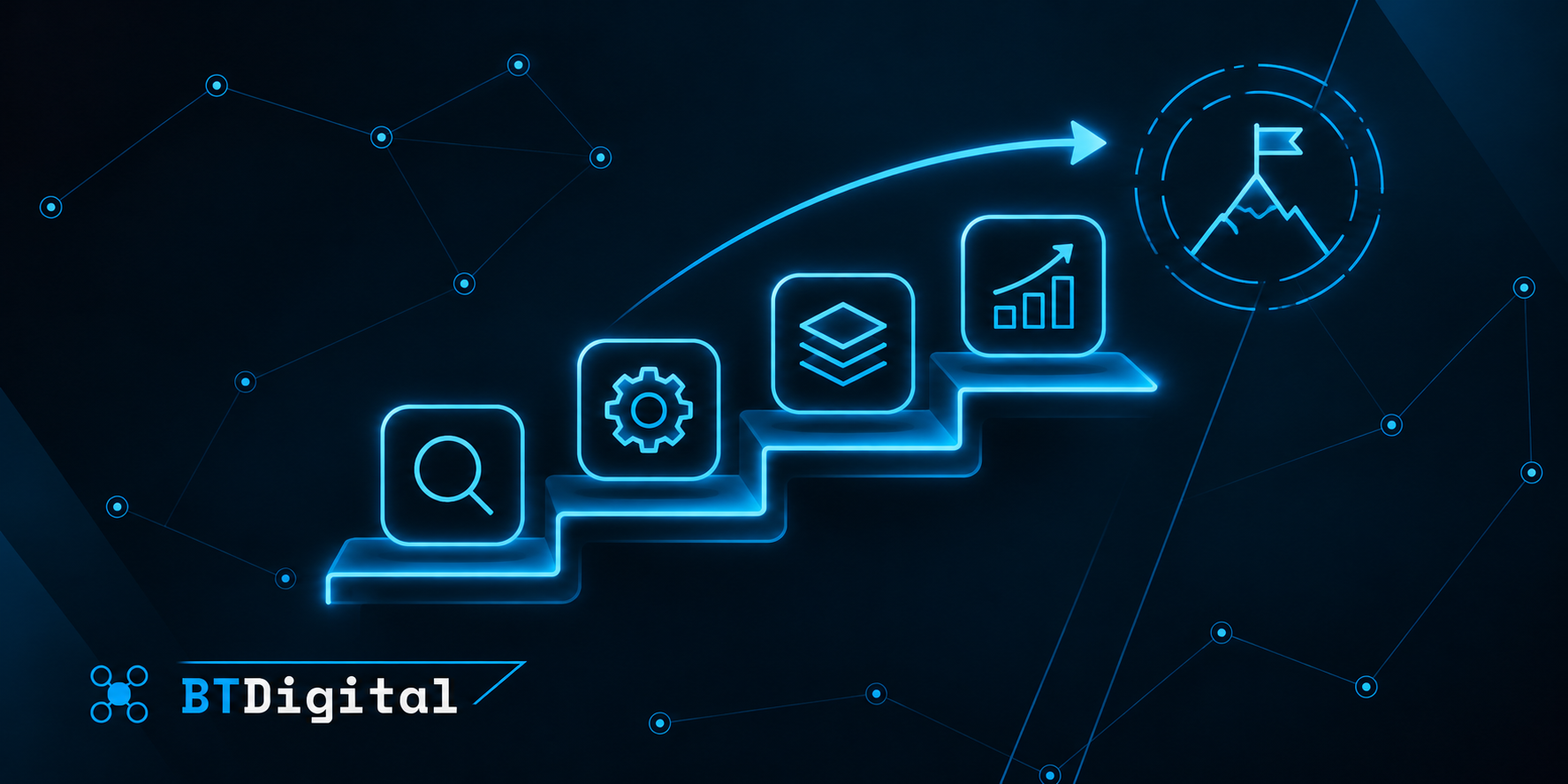
It is therefore useful to approach development as a sequence of connected steps.
Experience gained from a successful first automation or integration project can provide a strong foundation for future decisions.
What mistakes should businesses avoid?
One common mistake is selecting a technology before identifying the problem it needs to solve.
New software does not automatically improve an inefficient business process.
Introducing too many systems at once, providing insufficient employee training or overlooking integration requirements can also create difficulties.
A company may end up purchasing several digital tools that cannot communicate effectively with one another.
Long-term operations, integration capabilities and future scalability should therefore be considered from the beginning.
Successful digital transformation does not necessarily start with the largest investment.
It starts with choosing the right first improvement.
How long does digital transformation take to pay off?
The return on investment depends heavily on the problem being addressed.
Automating a straightforward administrative process may deliver results relatively quickly, while introducing a complex business platform may represent a longer-term investment.
The benefits should not be evaluated solely through direct cost savings.
Time saved, fewer errors, faster customer service and better access to business information can also create substantial value.
Prioritising improvements carefully can help businesses achieve tangible results even during the early stages of digital transformation.
The BT Digital approach
BT Digital approaches digital transformation as the deliberate improvement of business operations rather than simply the introduction of new software.
The starting point is understanding existing workflows and the technology environment: where unnecessary manual work occurs, which systems cannot exchange information and which improvements could create genuine business value.
Depending on the situation, the appropriate solution may involve integrating existing applications, automating repetitive processes, developing a custom web or internal business application, or introducing new backend and API connections.
BT Digital can support these initiatives through custom software development, automation and system integration solutions.
The objective is not to transform every process simultaneously, but to implement connected improvements that make business operations more efficient, transparent and sustainable over time.