Do You Need New Software, or Can You Get More from Your Existing System?
A business rarely runs on a single software system.
There may be a separate system for sales, invoicing, inventory, project management, e-commerce, or customer management.
For a while, this can work well.
Problems often appear when the systems do not communicate properly. The same data has to be entered several times, information has to be transferred manually, or an important process becomes fragmented across different applications.
This raises an important question:
Is new software really needed, or is there more potential in the systems already in place?
The answer is not always obvious. Several factors are worth reviewing before making a decision.
When can the existing system be enough?
An existing software system may offer more possibilities than expected.
It is worth checking:
- which features are already available,
- what configuration options exist,
- whether an API is available,
- which external systems can be connected,
- what automation options are supported,
- and which data can be imported or exported.
Sometimes the current system can already handle the required task, but a feature has not been configured or the system has not been connected to the rest of the process.
In this situation, reviewing the existing possibilities may be more useful than immediately introducing a new system.
When is integration worth considering?
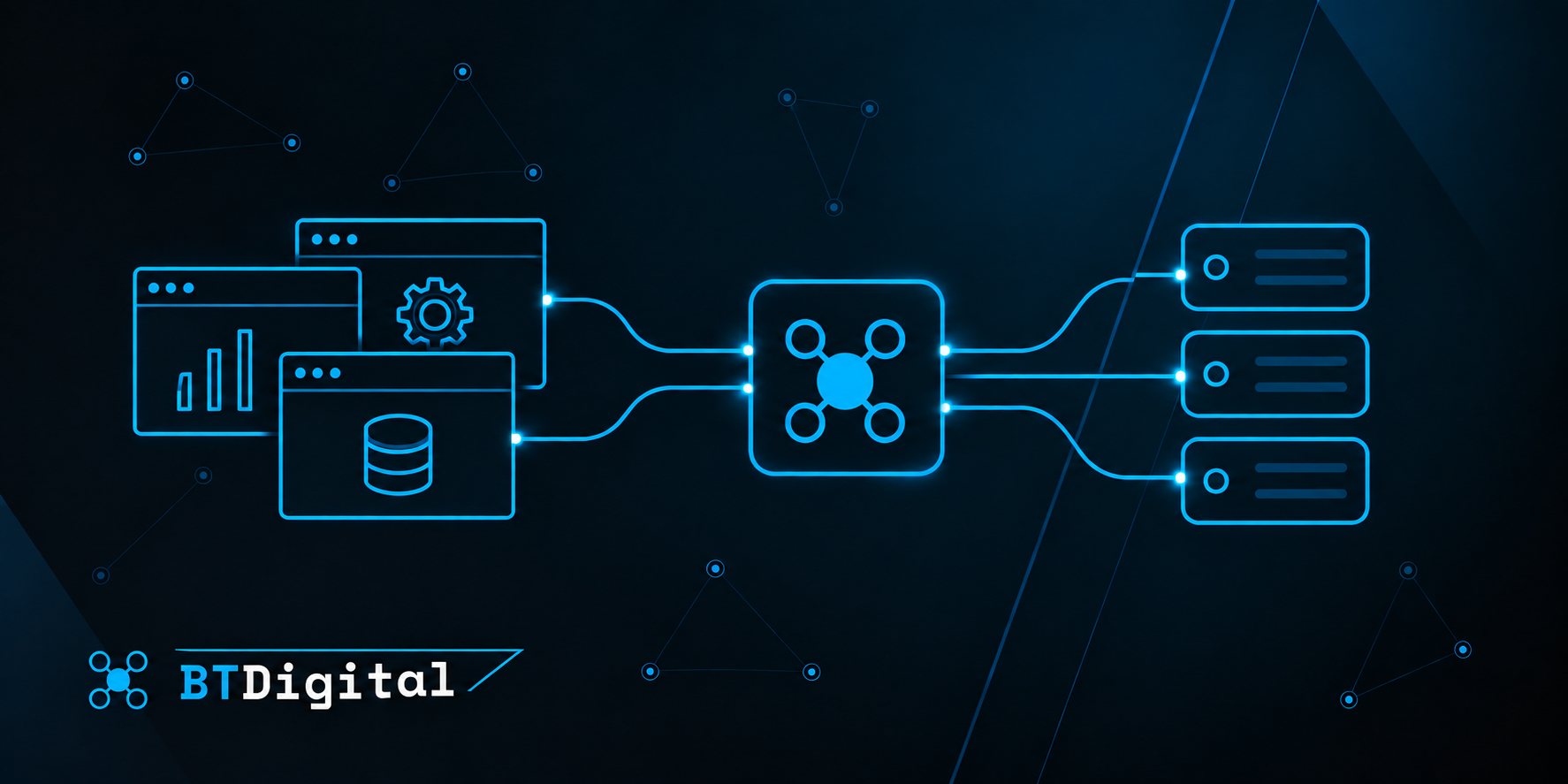
If several systems work well individually but do not communicate properly, integration can be a practical solution.
For example, an online store may manage orders, an ERP may manage inventory, an invoicing system may handle invoices, and a CRM may manage customer relationships.
Without integration, the same information may need to be entered manually in several places.
With a properly designed integration, selected data can be transferred automatically between systems.
For example:
Online store → ERP → invoicing → delivery
or:
Lead → CRM → quotation → task → notification
The goal of integration is not necessarily to move everything into one large system.
In many cases, the better solution is to keep the existing software and make the systems communicate properly.
When is integration not enough?
Integration works well when the connected systems are still able to support the business requirements.
If the actual process or the systems themselves have major limitations, an API connection alone will not solve the underlying problem.
For example, integration may not be enough when:
- neither system can properly handle an important process,
- a key business function is missing,
- too many manual exceptions are required,
- the data structure is not suitable,
- or the system requires constant workarounds.
In these situations, a new system or custom development may be worth considering.
When can a new system be justified?
A new software system may be appropriate when the current solution can no longer support important business requirements.
Typical examples include:
- an important process cannot be managed properly,
- the system cannot handle growing amounts of data,
- too much manual work is required,
- important reports are missing,
- required external integrations are not possible,
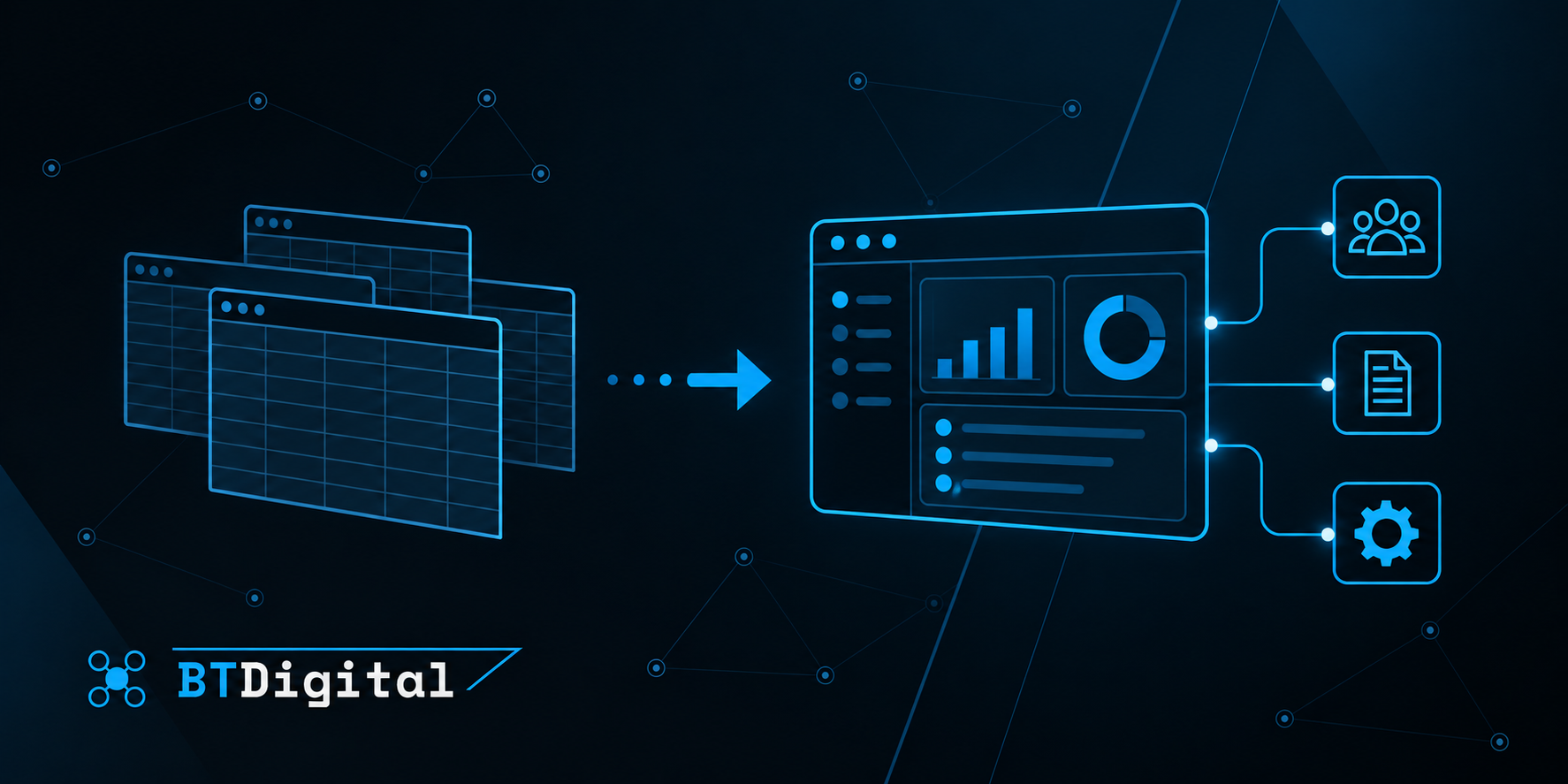
- or a large part of the process is managed in separate Excel files.
Even then, a single new application is not always the answer.
The solution may involve a new CRM, an ERP system, a custom web application, or a combination of several connected systems.
“Everything in one system” is not always the goal
At first, it may seem logical to manage every process in one system.
This is not always the best option.
A business may already have an invoicing system, online store, or external service that works well and supports its specific purpose.
There may be no reason to replace it simply to keep everything in one place.
A well-designed integration may be a better solution.
The goal is not necessarily to keep everything in one system.
The goal is to make sure the right information reaches the right place at the right time.
How should the decision be made?
The decision is best approached from the business processes rather than from the software itself.
A useful starting point is to identify:
- Which systems are currently in use?
- What data does each system manage?
- Where does manual data entry take place?
- Where does the same information have to be entered more than once?
- Which processes work well?
- Which processes create problems?
- Which important functions are missing?
- Which integrations are required?
This makes it easier to decide whether an existing system can be improved, whether integration is enough, or whether a completely new solution is justified.
The BT Digital approach
At BT Digital, the starting point is understanding the business processes before selecting a software solution.
The goal is to identify where the current systems work well, where limitations exist, and which problems can be solved with a simpler approach.
A well-designed integration can often be more efficient and less disruptive than replacing an entire system.
In other situations, continuing to develop an old or limited system may no longer be practical, and a new CRM, ERP, or custom business application may be the better direction.
BT Digital works with custom web applications, CRM and ERP systems, APIs, and system integrations.
The starting point is always the business problem:
The question is not simply which software should be replaced, but how the process can work in a simpler, more reliable, and more efficient way.