Not every automation is artificial intelligence
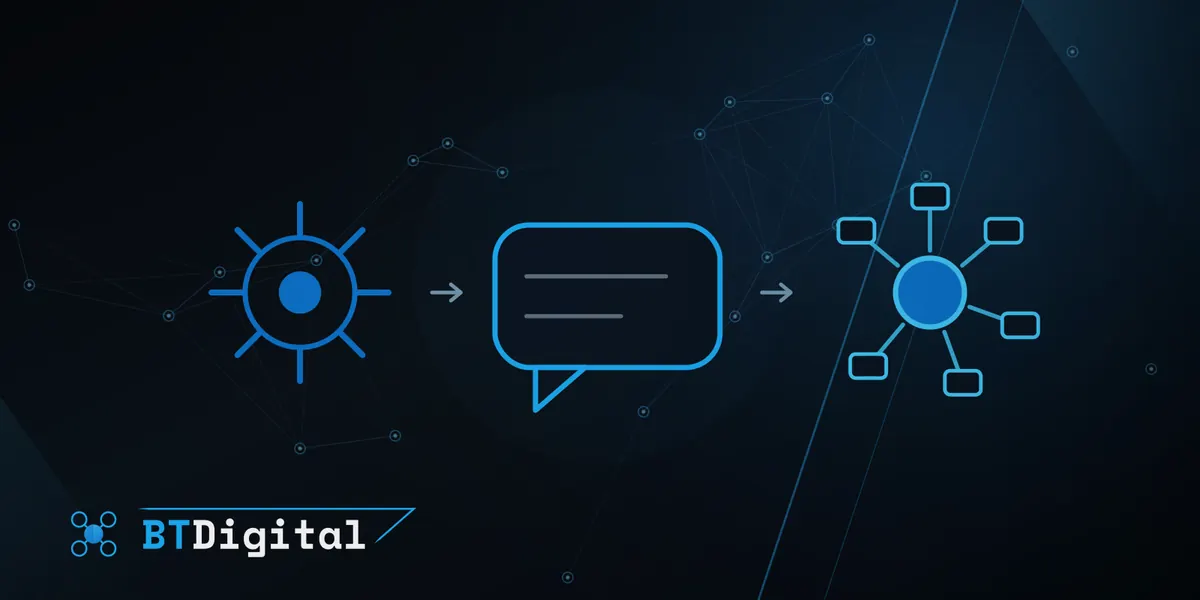
An automated email, a website chatbot and an AI agent that performs actions across multiple systems have very different capabilities and risks. At BT Digital, AI is not the objective. The objective is to improve a process, reduce manual work or create a better customer experience. If deterministic rules solve the problem more reliably, generative AI is unnecessary.
1. Traditional automation
Traditional automation follows predefined rules. Examples include creating a CRM record from a form, sending an email after an invoice, starting an approval workflow above a threshold or synchronising data between systems.
It is predictable, testable, auditable and usually economical. Its limitation is that complex free text and numerous exceptions can create an unmanageable rule set.
2. AI chatbot
An AI chatbot communicates in natural language. It may search an approved knowledge base, ask clarifying questions, summarise information and route a customer to the correct process.
Useful applications include service FAQs, product guidance, initial requirement collection, internal document search and support triage. A well-designed chatbot must recognise uncertainty and hand the conversation to a person rather than inventing an answer.
Important questions include the source of knowledge, update frequency, personal data handling, fallback behaviour, logging and whether users are clearly told that they are interacting with AI. EU AI Act transparency requirements applying from 2 August 2026 make this distinction particularly relevant.
3. AI agent
An AI agent can plan multiple steps and use tools to achieve a goal. It may retrieve data, prepare documents, create tasks or initiate an action after approval.
Examples include summarising enquiries into CRM, preparing quotations, categorising support tickets, producing reports from several systems and starting external workflows after human review.
The broader the access, the stronger the controls must be: least privilege, human approval, action limits, logging, usage caps, hostile-input handling and realistic testing. An agent should not receive broad administrative access merely because it can technically use it.
Comparison
| Aspect | Traditional automation | AI chatbot | AI agent |
|---|---|---|---|
| Main purpose | Execute repeatable rules | Conversation and information | Multi-step tasks and tool use |
| Predictability | High | Medium | Lower; requires controls |
| Free-text handling | Limited | Strong | Strong |
| External actions | Predefined | Usually limited | Possible with strict permissions |
| Human oversight | Process-dependent | Required for critical topics | Often mandatory |
| Running cost | Usually lower | Usage-based | More variable and potentially higher |
How to choose
Use traditional automation when rules and data are clear. Use a chatbot when users ask repeated questions in natural language and a maintained knowledge base exists. Use an agent when the task is multi-step, information comes from several systems and human approval can remain part of the process.
A good first AI project
Start with a narrow, measurable and reversible use case: an internal FAQ assistant, email classification without automatic sending, support response drafts with approval or document summaries without sensitive actions. This allows accuracy, time savings and errors to be measured while risk remains controlled.
Cost considerations
AI solutions may include model usage, vector search, speech services, hosting, integrations, knowledge-base maintenance, quality review, monitoring and continuous workflow refinement. A practical commercial model often combines an initial setup fee, monthly operations and usage-based external cost.
The BT Digital approach
We first identify repeated work, waiting time and information loss. We then decide whether rules, a chatbot, an agent or a combination is appropriate. AI value is measured through real operation: accuracy, time saved, security, cost and human control.
Good AI is useful in a specific task, and its limitations are as clear as its capabilities.
Professional background
This article follows the risk-based approach of the NIST AI Risk Management Framework Generative AI Profile and the European Commission’s current AI Act transparency guidance.