How to Choose a Software Development Company: 7 Key Factors to Consider
Developing a new business application, web platform or system integration can be an important investment for a company. Choosing the right technology partner can be just as significant as the development project itself.
When evaluating software development companies, it is easy to focus primarily on pricing or previous projects. However, a successful collaboration depends on several additional factors.
The right development partner should understand the business problem, communicate clearly, recommend suitable technical solutions and consider the long-term operation of the system.
The following seven factors can help businesses make a more informed decision.
1. Does the company understand the business problem?
A successful software development project does not necessarily begin with choosing a technology.
The first priority should be understanding the problem that needs to be solved.
For example, a company may want a new administration platform because employees spend too much time managing data manually. However, the most appropriate solution may not be an entirely new application.
Extending an existing system, connecting two applications or introducing a smaller automation may be sufficient.
It is therefore worth paying attention to the questions a potential development partner asks during the first meeting.
Do they ask about existing workflows? Do they want to understand who will use the software? Do they explore current systems, operational difficulties and the business objectives behind the project?
Understanding business requirements helps ensure that development addresses an actual problem rather than simply delivering a list of features.
2. Does the company have relevant experience?
Previous projects and references can provide useful insight into a development company's capabilities.
Experience in exactly the same industry is not always the most important factor.
It may be more relevant to determine whether the company has handled technical challenges similar to those involved in the planned project.
For a complex business system, experience with backend development, data management, access control or external integrations may be especially valuable.
For a customer portal, user workflows, secure access and system architecture may play a greater role.
When reviewing references, it is therefore useful to look beyond the visual appearance of previous projects.
The key questions are what problems were solved and which responsibilities the development company handled.
3. Is the development process transparent?
Software projects often take place over several months and involve numerous decisions.
It is important for the client to understand the development stages, when results can be expected and how feedback will be handled.
Useful questions include how requirements are gathered, when the first working features will be available, how frequently progress is reviewed and how changes are managed during development.
A transparent process does not mean that every detail can be predicted with complete certainty.
It means that progress, upcoming steps and potential risks remain visible.
This is particularly important for businesses without their own technical teams.
4. How is the project priced?
When comparing software development proposals, the total price alone can be misleading.
Two proposals may differ significantly because they do not include the same scope of work.
One proposal may cover requirements analysis, planning, development, testing and deployment. Another may include only the implementation itself.
It is therefore important to examine exactly which features, services and deliverables are included.
The process for handling new requirements during development should also be clarified.
The lowest initial price does not necessarily result in the lowest overall project cost.
A good proposal should make its scope, assumptions and potential additional costs understandable.
5. How important is communication?
Communication between the client and the development team has a direct impact on the quality of collaboration.
This is especially important when the client does not have extensive technical knowledge.
A suitable development partner should be able to explain proposed solutions, their advantages, limitations and potential risks in accessible language.
The client does not need to understand every technical detail. However, the business consequences of important decisions should be clear.
Early meetings can provide valuable insight into how questions are answered, how clearly information is communicated and how easily the two parties can establish a shared understanding.
Good communication is not simply a matter of convenience.
It can help prevent misunderstandings, unnecessary changes and the additional costs they may create.
6. Does the company consider long-term maintenance?
The value of software is not determined on the day it is delivered.
The system needs to remain reliable and adapt to changing business requirements over time.
It is therefore worth evaluating how much attention the development company gives to maintainability, security, documentation and scalability.
Other important questions include how issues will be handled, who will be responsible for operation and how future features can be introduced.
Ignoring long-term requirements can lead to significant costs later.
A well-designed system, on the other hand, can make it possible to introduce new functionality or connect additional services without rebuilding the entire application.
7. Does the company act as a partner or simply execute tasks?
The relationship between a business and a development company does not necessarily have to be limited to providing requirements and receiving finished software.
An experienced technology partner can highlight considerations that may not have been obvious during the initial planning stage.
For example, they may recommend a simpler alternative to an unnecessarily complex feature, identify integration risks or help prioritise functionality for the first release.
This does not mean that the development company should make business decisions on behalf of the client.
The client understands its own business and objectives, while the development partner brings knowledge of technical possibilities and limitations.
Combining these perspectives can lead to better solutions.
What questions should be asked during the first meeting?
A few targeted questions can make it easier to evaluate potential development partners:
Has the team worked on similar projects before?
How are business requirements identified and documented?
What stages are included in the development process?
When will the first working parts of the system be available for review?
How are new requirements handled during the project?
What is included in the proposal, and what additional costs might arise?
How are testing and deployment managed?
What support is available after delivery?
The answers can reveal not only technical capabilities but also how the collaboration is likely to work in practice.
The BT Digital approach
BT Digital approaches software development by first understanding the business problem and identifying an appropriate technical solution.
When developing custom web and business applications, backend systems, APIs and integrations, it is particularly important that the solution fits the company's existing processes and technical environment.
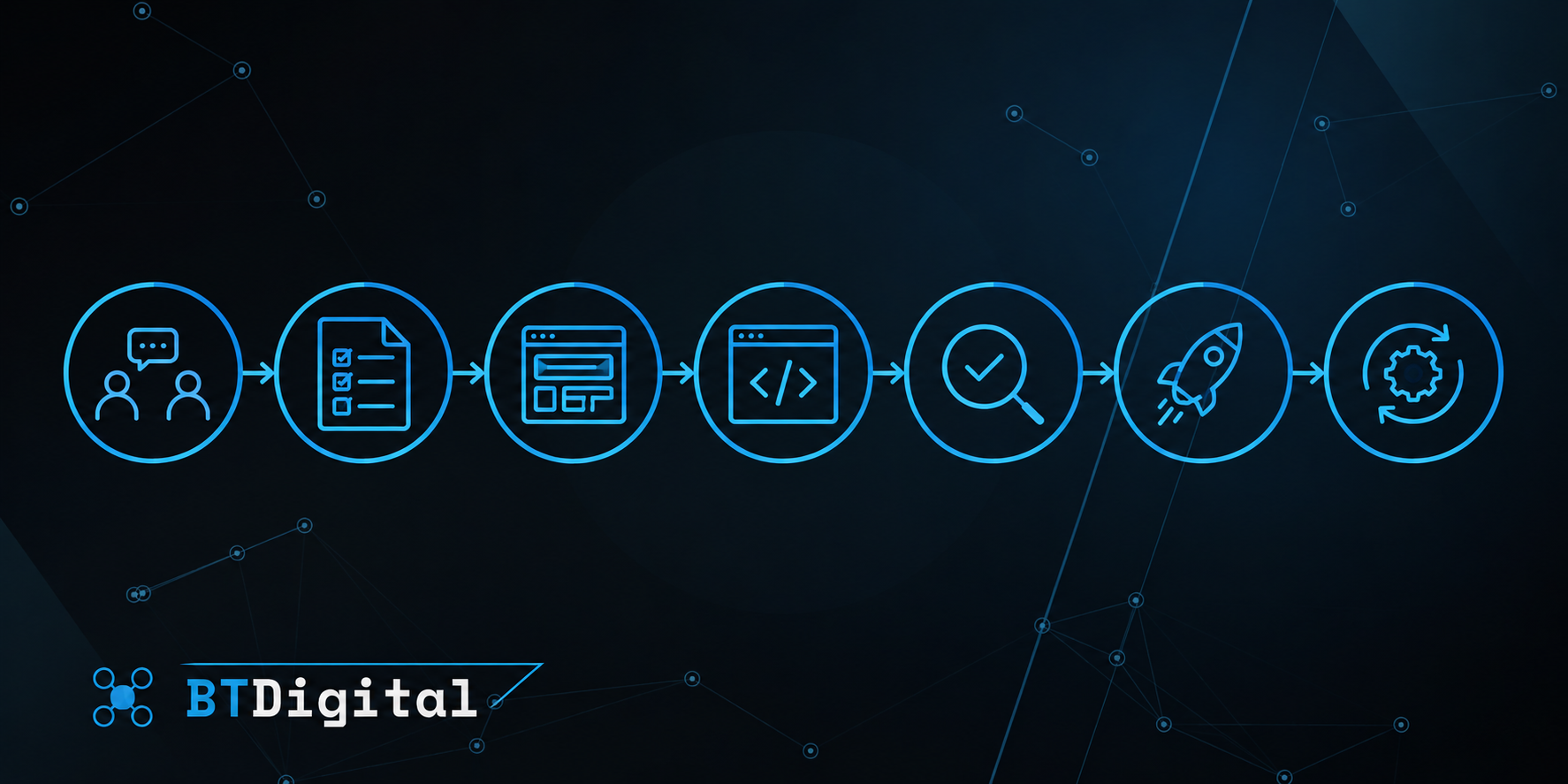
The development lifecycle involves requirements analysis, technical planning, implementation, testing and deployment. The objective is not simply to deliver the requested functionality, but to create a system that remains useful, maintainable and adaptable over time.
When selecting a development partner, businesses should therefore consider more than technical expertise and price. Transparent collaboration, a clear understanding of business needs and a focus on long-term value are equally important.