APIs Explained Simply: How Different Software Systems Communicate
The term API appears frequently in discussions about software, websites, applications and automation. At first, it may sound highly technical, but the basic concept is relatively simple: an API allows different software systems to communicate with each other.
An online store can send order information to invoicing software. A CRM can retrieve customer information from another system. A mobile application can display information stored in a central business platform.
In many cases, APIs are what make these connections possible.
What is an API?
API stands for Application Programming Interface.
Instead of starting with the technical definition, it can be easier to understand the concept through a familiar example.
In a restaurant, customers do not need to enter the kitchen to order a meal. An order is placed, the kitchen processes it, and the result is returned.
An API can play a similar role between two software systems.
One system makes a request in a predefined way, another system processes that request and returns a response.
The two applications do not need to understand every detail of each other's internal operation. They only need to know how to communicate through the available interface.
A simple example: an online store and invoicing software
Consider an online store receiving a new order.
Without an API connection, the order information may need to be transferred manually to the invoicing system: customer name, address, products, prices and other required details.
If the two systems have a suitable API connection, this process can be automated.
The online store sends the required information to the invoicing system, which processes the data and performs the predefined operation.
Technical communication takes place in the background, but from a business perspective the result is straightforward: less manual data entry may be required.
Is an API like a common language?
In some ways, yes.
Two software systems can be built using completely different technologies. One might be an e-commerce platform, another a CRM, while a third could be a custom internal application.
For them to work together, they need a predefined method of communication.
An API can define:
what information can be requested,
what information can be sent,
how that information should be structured,
what operations can be performed,
and what type of response the system provides.
This makes it possible for independently developed software systems to exchange information.
Where are APIs used?
APIs operate behind many digital processes that users experience as completely ordinary.
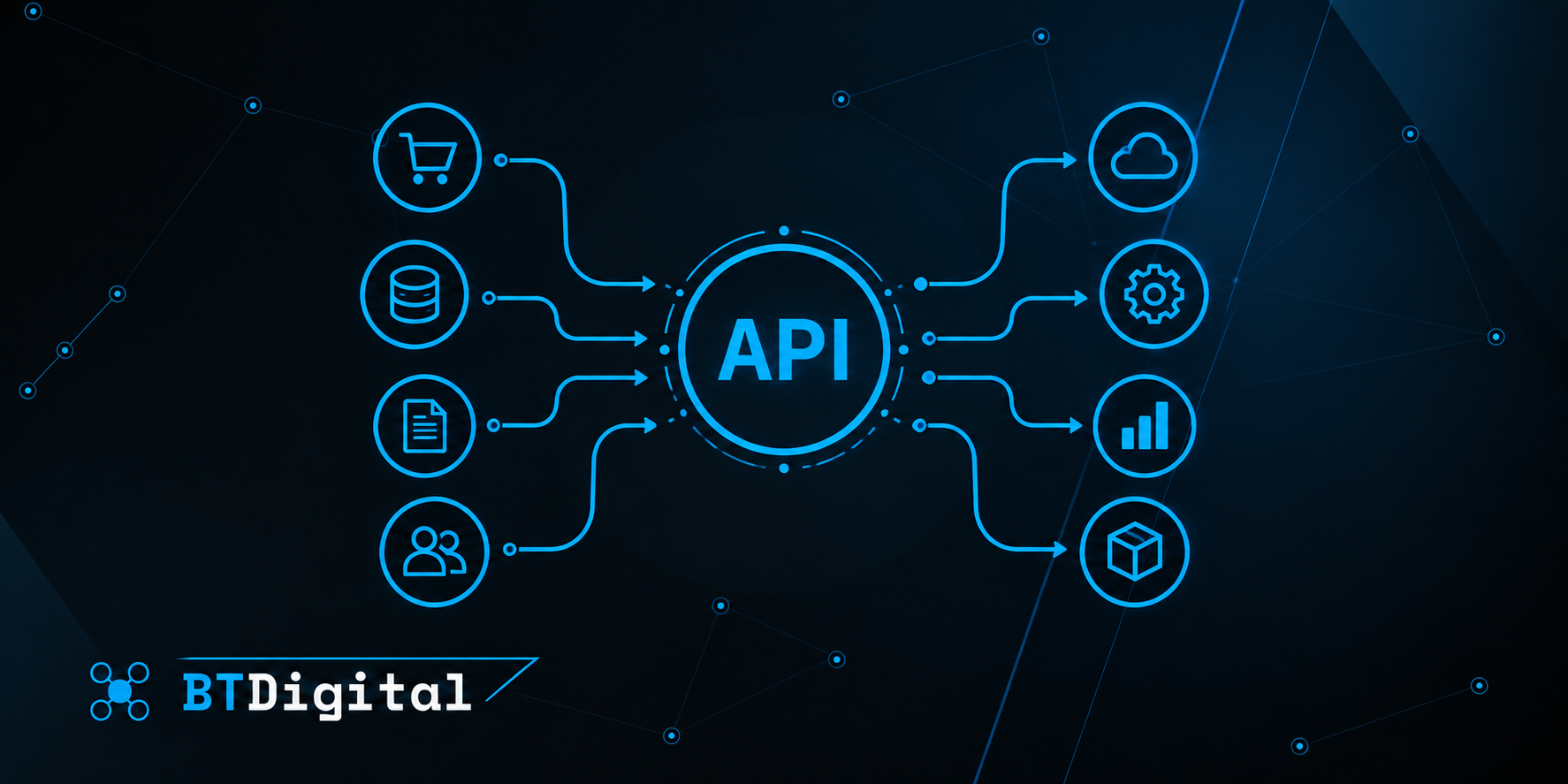
An e-commerce platform, for example, may communicate with:
invoicing software to provide the information required to generate invoices,
shipping providers to transfer delivery details,
inventory or ERP systems to update stock and order information,
payment providers to handle online transactions,
or a CRM system where customer information can be stored and managed.
APIs are not limited to e-commerce. Mobile applications, ERP systems, customer portals, internal administration platforms and many other digital solutions can rely on APIs.
Why are APIs useful for businesses?
An API is a technical tool. Its business value comes from the processes it can simplify or help automate.
Less manual work
If the same information is required by multiple systems, it does not necessarily need to be entered manually each time.
Information that already exists in one application can be transferred automatically to another.
Fewer opportunities for errors
Manual data entry introduces the possibility of typing and copying errors.
Automated data exchange can reduce the number of points where the same information has to be entered repeatedly.
Faster processes
A system does not necessarily have to wait for someone to transfer information manually.
An order, status change or other event can trigger the next step of a process automatically.
Connecting existing software
One important benefit of APIs is that an additional business requirement does not always mean that existing software needs to be replaced.
If the necessary technical options are available, separate applications can be connected and made part of a larger business process.
What is a REST API?
A REST API is one of the most widely used types of API, particularly in web-based systems.
Its technical details can become more complex, but from a business perspective the same basic principle applies: one system requests or sends information to another in a predefined way.
A CRM, for example, might retrieve customer information, create a new record or update an existing one.
These operations take place through controlled interfaces, making it possible to define exactly which data and functions an external system can access.
What is a webhook?
The term webhook often appears alongside APIs.
One simplified way to understand the difference is to consider when the communication begins.
With a traditional API request, one system asks another system for information. With a webhook, a system automatically sends a notification when a particular event occurs.
For example, when an online payment is successfully completed, the payment system can use a webhook to notify the online store immediately. The store does not need to continuously check whether the payment has arrived.
Similar events might include a new order, a status change, a registration or another predefined action.
Can every system be connected through an API?
Not necessarily.
A system needs to provide a technical method through which other applications can access the required information or functionality.
Many modern cloud-based services offer APIs, but this is not always the case with older or specialised software.
A system may also provide an API without exposing every function required for a particular integration.
Before planning an integration, it is therefore important to understand what connection options are available in each system.
An API is not the same as automation
The two concepts are closely related, but they are not identical.
An API can provide the communication channel between two systems. Automation determines when and under what conditions a particular action should take place.
An online store and an invoicing platform, for example, may be able to communicate through an API. The automation can determine at which order status the information should be transferred, when an invoice should be created and what should happen if required information is missing.
An API therefore often provides the foundation on which more complex automated processes can be built.
When is custom API development necessary?
Integration does not always involve connecting APIs that already exist.
A custom business system, web application or mobile application may require its own API so that other systems can access specific information and functionality.
This may be necessary when a mobile application connects to an internal business platform, external partners need controlled access to certain data, or several applications need to use the same central data source.
In these situations, the API becomes an important part of the overall system architecture.
APIs work in the background, but their impact is visible in business processes
Most users never interact with an API directly.
It does not usually appear as a separate button on a website and is generally invisible while an application is being used.
Its impact, however, can be clearly visible.
Information does not need to be entered twice. An order can automatically move to the next system. An application can display up-to-date information. Separate software solutions can operate as parts of one connected business process.
For this reason, an API does not create business value simply by existing. The important question is which systems and processes should be connected through it.
The BT Digital approach
BT Digital approaches API development and system integration as part of the wider business process rather than as an isolated technical task. The starting point is to determine what information needs to move between systems, when that exchange should take place and which processes can be simplified or automated.
BT Digital develops scalable backends, REST APIs, webhooks and custom system connections to support communication between different applications and business systems. Integrations can involve e-commerce platforms, CRM and ERP systems, invoicing software, email and calendar services, as well as custom applications.
The objective is not to use an API simply for the sake of the technology, but to create a stable connection between systems that makes the underlying business process simpler and more efficient.