Why Partner Up exists
IT projects often require several disciplines: design, backend engineering, integrations, legal content, marketing, operations or industry knowledge. At the same time, clients and professional contacts frequently meet businesses that need a reliable technology partner.
Partner Up is designed to turn these connections into transparent cooperation with defined roles, responsibilities, client handling and commercial terms.
Who can apply?
- Referral partners who introduce relevant development, automation, CRM, ERP, web or mobile opportunities.
- Professional partners such as developers, designers, QA, security and operations specialists.
- Technology and business partners whose services complement BT Digital projects.
- Existing clients who would like to recommend BT Digital to another business.
Possible cooperation models
One-time referral
A partner introduces a potential client. If the introduction can be identified and results in a signed and paid project, a success fee or another benefit may be agreed separately. No percentage is automatic; the value depends on project economics, partner involvement and whether the client relationship already existed.
Service credit for an existing client
Instead of cash, an existing client may receive a time-limited operations discount or additional support allowance. Conditions must be agreed in writing.
Mutual referral
Where BT Digital does not provide a requested service, we may introduce a suitable partner with the client’s permission. Third-party personal data should not be uploaded or transferred without an appropriate legal basis. A safer method is for the interested party to submit their own request or use a referral link.
Joint project delivery
A partner may own a defined workstream. The agreement must clarify contracting, deliverables, project management, client communication, change control, fee or profit allocation, intellectual property, confidentiality and data processing.
A phrase such as “50/50 profit” is insufficient unless revenue, deductible costs and risk ownership are clearly defined.
White-label or subcontracting
BT Digital may deliver technical work for another provider, or a partner may join a BT Digital project. Reference rights, communication and client ownership must be documented.
Application process
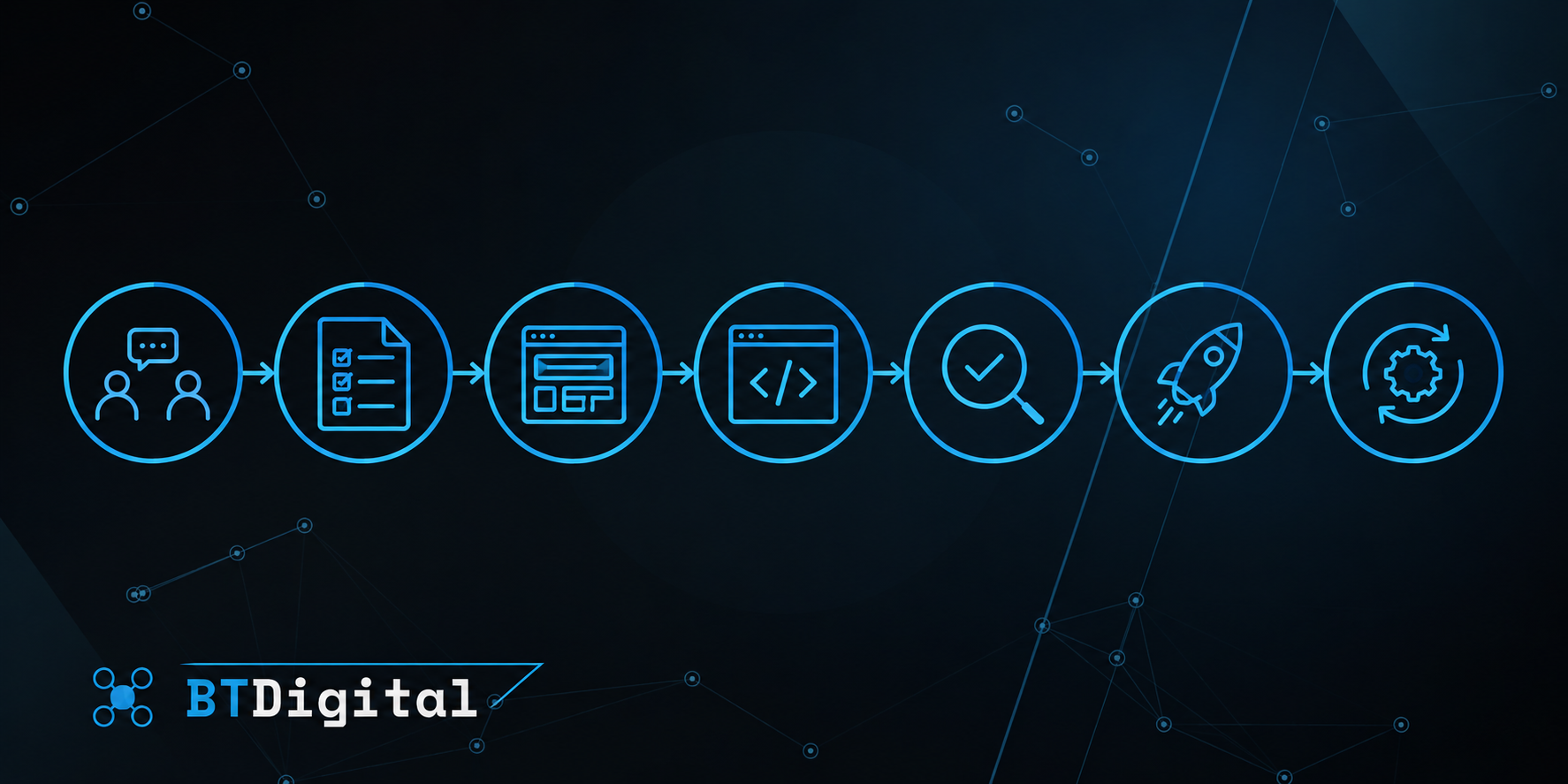
The applicant provides name, email, phone number and partnership type. Company, role, website, LinkedIn and introduction are optional. BT Digital reviews the fit, holds a short conversation and prepares a separate written agreement if a specific opportunity exists.
Submitting the form does not itself create a partnership, agency, subcontracting or exclusivity relationship.
When is a success fee payable?
A written referral record should define the client, date, existing relationship, relevant service, success event, fee basis, payment timing, validity period and invoicing conditions. A fee may, for example, become payable only after BT Digital has actually received the agreed client payment.
Client protection and transparency
The programme does not authorise unsolicited marketing or the unauthorised submission of third-party data. A partner may not promise pricing, deadlines, technical scope or legal commitments on behalf of BT Digital without written authority.
Clients should always understand who contracts, who processes data, who is responsible for delivery and how the participating parties are related.
Core principles
- No automatic or hidden commission.
- Commercial terms are documented in writing.
- Client interest and transparency come first.
- Third-party data is processed only with an appropriate legal basis.
- Partners cannot bind BT Digital without authority.
- Quality and responsibility are more important than quickly monetising a contact.
Legal note
The public programme description is informational. Long-term agency, subcontracting, joint bidding or profit-sharing arrangements require a situation-specific contract and, where appropriate, legal and tax review.
Application creates no obligation. After an introduction and short discussion, both parties decide whether a suitable cooperation model exists.