CRM or ERP? Understanding the Differences and Choosing the Right System
CRM and ERP are two common terms in business software, but the difference between them is not always clear. Both systems are designed to make business operations more transparent and efficient, but they focus on different areas.
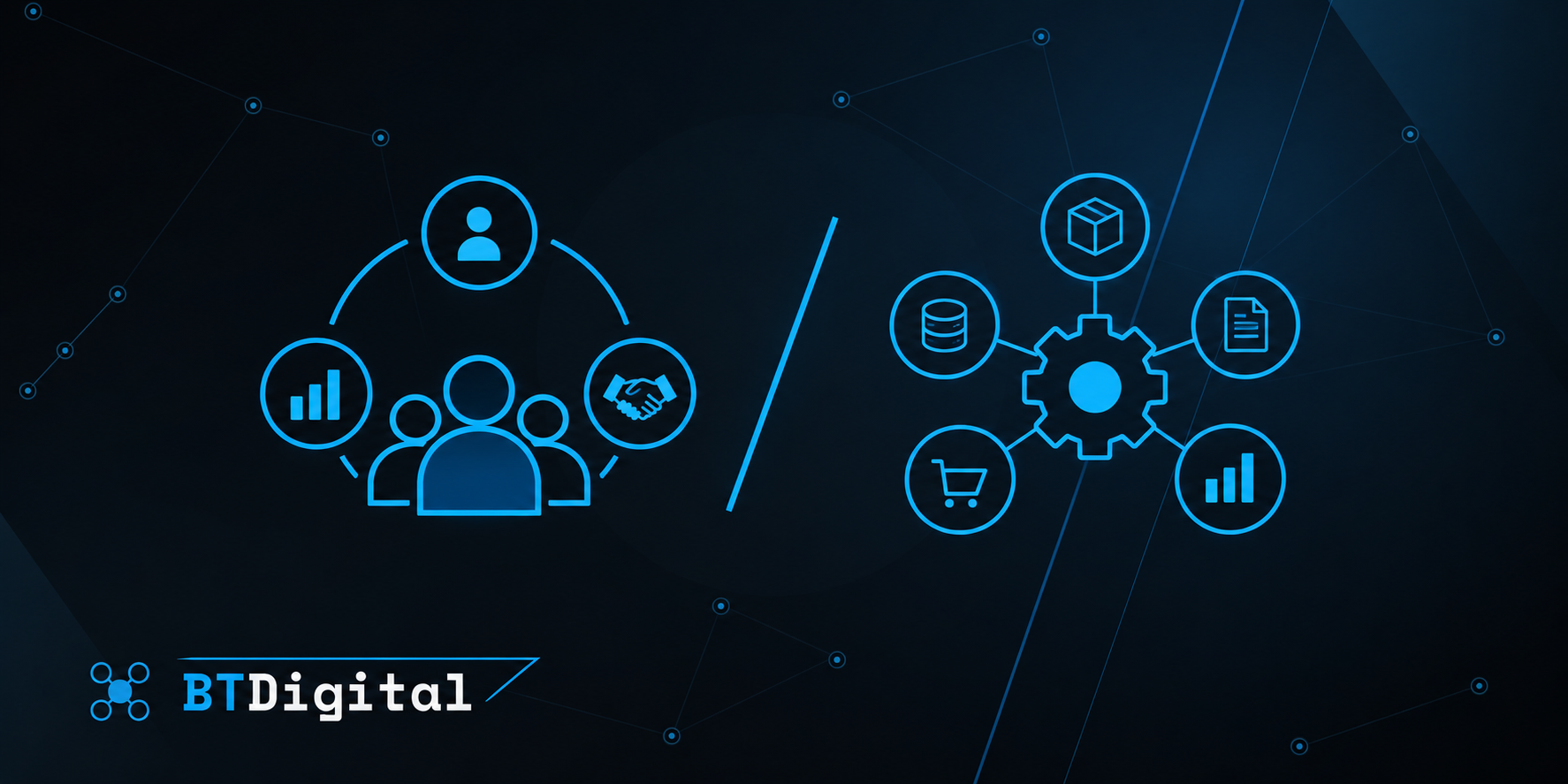
A CRM primarily manages processes related to customers and sales, while an ERP connects multiple areas of internal business operations. However, the two systems are not necessarily alternatives to each other. In many cases, they work together.
Choosing the right solution therefore starts with identifying which parts of the business currently create the problems that a new system needs to solve.
What is a CRM?
CRM stands for Customer Relationship Management. A CRM system supports customer relationships and sales processes.
It can provide a central place to manage:
- leads and customer information,
- sales opportunities,
- quotations and their statuses,
- communication history,
- tasks and next steps,
- the sales pipeline.
The objective is to prevent customer information from being scattered across spreadsheets, emails or individual employees and instead make it available in a shared system.
This becomes particularly important as the number of leads and customers grows, more people become involved in sales, or it becomes increasingly difficult to see the current status of each business opportunity.
What is an ERP?
ERP stands for Enterprise Resource Planning and usually covers a broader area. Its main purpose is to connect and manage internal business operations and resources.
An ERP system may handle:
- products,
- inventory,
- orders,
- procurement,
- projects,
- parts of financial or invoicing processes,
- reporting and business data.
The purpose of an ERP is to prevent related internal processes from operating in isolated systems and spreadsheets.
An order, for example, may affect inventory, procurement, invoicing and reporting. Without proper connections between these areas, the same information may need to be entered several times, creating unnecessary administration and increasing the risk of errors.
What is the main difference between CRM and ERP?
The simplest distinction is their primary focus.
CRM primarily looks towards the customer.
It supports the management of leads, customers, sales opportunities and communication processes.
ERP primarily connects internal business operations.
It supports the management of orders, inventory, procurement, projects and other operational processes.
However, the boundary is not always strict. Modern business systems may contain both CRM and ERP functionality within the same platform.
For this reason, the name of the software is often less important than the business processes it needs to support.
When is a CRM more relevant?
A CRM may be appropriate when the main problems are related to sales and customer management.
Typical examples include difficulties tracking where a lead came from, when the last interaction took place, which quotation was sent or when the next follow-up should happen.
A CRM can also become useful when several salespeople work with the same customer base, information is scattered across emails and spreadsheets, or there is no clear overview of the sales pipeline.
In these situations, implementing a complete enterprise resource planning system may not be necessary. A well-designed CRM can already solve significant operational problems.
When is an ERP more relevant?
An ERP becomes more relevant when the main problems occur within internal business operations rather than customer relationships.
This may happen when orders, inventory, procurement and projects are managed in separate systems, or when the same data needs to be entered manually in several places.
Increasing transaction volumes and more complex internal processes can also create a need for ERP functionality.
In this situation, an ERP is not simply another administrative interface. It becomes a common system connecting related business processes.
CRM or ERP? It is not always necessary to choose
CRM and ERP systems are not mutually exclusive.
A business process may begin in a CRM. A lead becomes a customer, a quotation is created and eventually an order is placed.
At that point, ERP processes may become relevant. Inventory may need to be checked, procurement initiated, an order processed or a project created.
When CRM and ERP systems are properly connected, information can move between them automatically, reducing the need to enter the same data multiple times.
This is particularly valuable for businesses where sales and fulfilment are closely connected.
One system or two separate systems?
CRM and ERP functionality can be implemented in several ways.
A single business system can contain both areas. A separate CRM and ERP can also be connected through integrations. In other cases, it may be sufficient to begin with a smaller CRM or ERP module.
There is no universally suitable architecture for every business.
A smaller service company may primarily need customer and sales management, while a company dealing with products, inventory, orders and procurement may require ERP functionality much earlier.
The system should therefore be adapted to actual business operations rather than forcing business operations to adapt to the software.
Which one should come first?
Before choosing between CRM and ERP, a more useful question is: which business process is currently causing the most problems?
If leads, quotations and follow-ups are difficult to manage, starting with CRM functionality may make sense.
If orders, inventory, procurement or project management create most of the manual work, ERP functionality may be more relevant.
If both areas create problems, the relationship between the processes should be examined to determine the most practical order for digitalisation.
It is not always necessary to implement every function at once. A smaller, clearly defined system or module can provide a starting point and later be extended with additional functionality and integrations.
BT Digital's perspective
Choosing between CRM and ERP should not begin with a software category but with the underlying business processes. The first step is to understand how sales, customer management, orders, inventory, procurement or project work currently operate and identify where unnecessary manual administration or duplicated data occurs.
BT Digital can support the design and development of custom CRM and ERP systems, smaller business modules, as well as integrations and automation connecting different systems. A solution can begin with a single clearly defined process and later expand with additional modules and integrations as business requirements evolve. The objective is not to include every possible feature in one system, but to ensure that the right functionality supports the right part of everyday business operations.