Why there is no single price for every project
Asking “how much does an app cost?” is similar to asking “how much does a building cost?”. The category alone does not define size, technical content, quality expectations or operating model.
A one-page corporate website, a customer portal and a multi-role mobile application are all digital projects, yet require very different levels of planning, engineering, testing and responsibility. Realistic pricing comes from scope, risk analysis and technical decomposition rather than guesswork.
The main cost components
1. Discovery and specification
Before development, the team must understand the business objective, users, target workflow, success criteria and the boundary of the first release. A specification is not unnecessary paperwork. It prevents the client and the development team from interpreting the same sentence differently.
2. User experience and design
Design includes information architecture, user journeys, screen logic, responsive behaviour and accessibility. Custom visual design creates value when brand experience, conversion or simplification of a complex process matters. In an internal system, clarity and speed may be more important than visual effects.
3. Frontend and backend
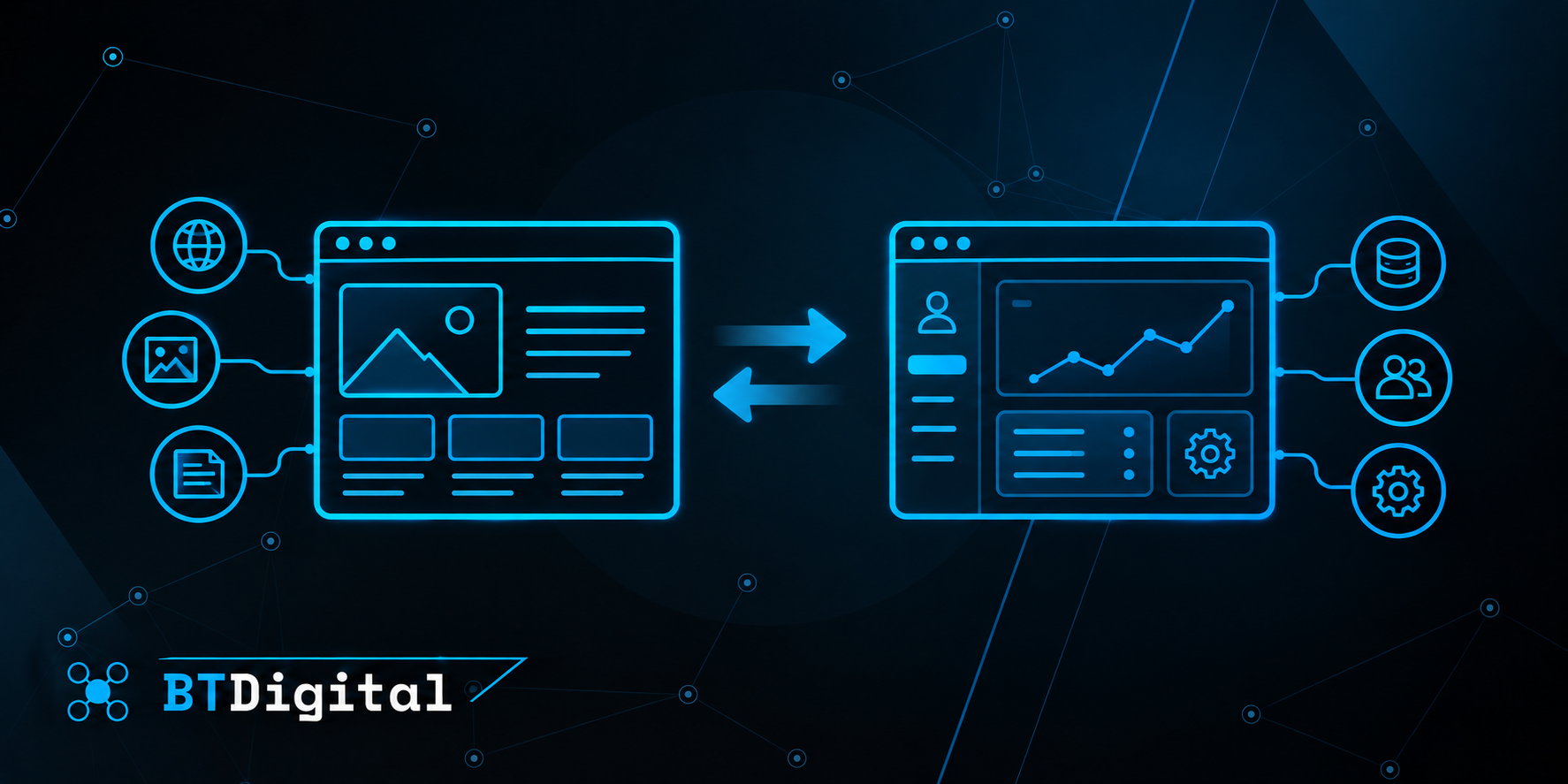
The frontend is what users interact with. The backend handles business rules, data, permissions, integrations and notifications. In a CRM or order management system, backend logic is often a major part of the work.
4. Administration interface
The public-facing interface is only one side of a system. The business may also need to manage content, users, orders, settings, reports and exports. A serious administration area can become a separate product with its own roles and workflows.
5. Integrations
Billing, ERP, CRM, payments, maps, email, SMS and third-party APIs introduce both effort and risk. Reliable integration also requires data mapping, error handling, retry logic, duplicate prevention and preparation for external changes.
6. Data migration
Moving data from spreadsheets or legacy systems requires profiling, cleaning, deduplication and validation. Migration should be treated as a separate project activity rather than an automatic side effect.
7. Testing and quality assurance
A solution that works on a developer’s machine is not necessarily production-ready. Core flows, invalid inputs, mobile views, permissions, browser compatibility, performance and regression must be checked. Defects are generally cheaper to fix before they affect customers or revenue.
8. Security and privacy
Systems that process personal, business or financial data need suitable access control, logging, encryption, backups and privacy processes. Security should be designed from the beginning rather than added during the last week.
9. Deployment, documentation and training
A project may also include domain and SSL setup, infrastructure, CI/CD, app store publication, administration guides, access handover and user training.
10. Operations and evolution
Browsers, mobile platforms, dependencies, APIs and security expectations continue to change. A digital system needs ownership after launch.
Think in total lifecycle cost
The first invoice is not the only relevant number. Total cost of ownership includes initial development, third-party services, hosting, support, monitoring, changes, migration and the business impact of defects or downtime.
A cheap, undocumented system may become more expensive over time than a well-structured solution delivered in controlled stages.
Fixed price, time-based or milestone delivery?
- Fixed price works when the scope and acceptance criteria are detailed and uncertainty is low.
- Time-based delivery is suitable for audits, takeovers and evolving backlogs where the correct solution emerges through investigation.
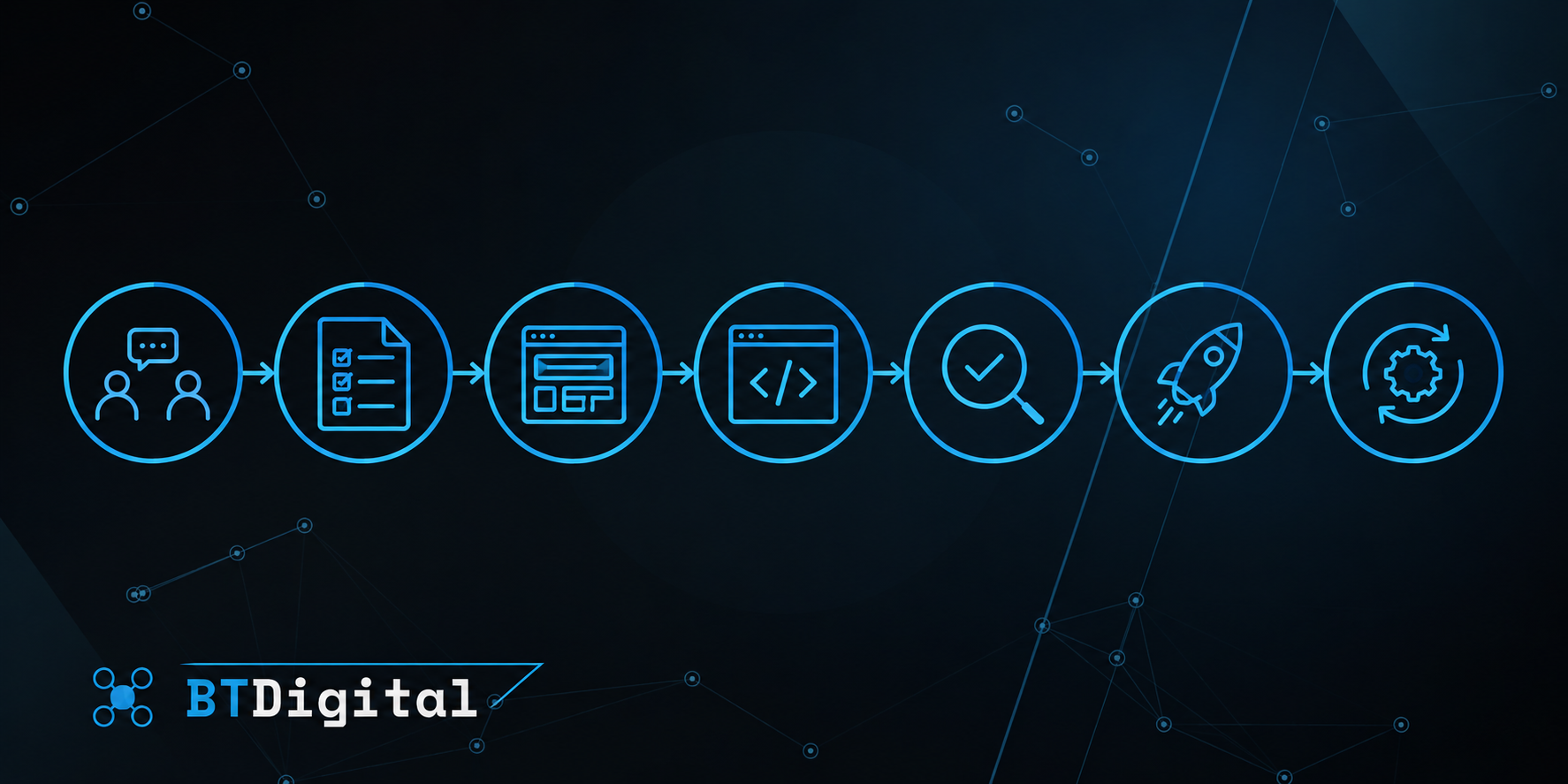
- Milestone delivery is often best for larger projects: discovery, design, MVP, integrations and launch each produce a reviewable outcome.
How to keep cost under control
- Separate essential features from later enhancements.
- Define an MVP around one business objective.
- Use measurable acceptance criteria.
- Review frequent demonstrations and maintain short feedback cycles.
- Reduce uncertainty through discovery and prototypes.
- Separate defect correction from new requirements.
- Budget for operations after launch.
Warning signs in an offer
Be careful when a provider gives a final price and deadline for a complex system without asking detailed questions. A professional proposal should state the deliverables, exclusions, client responsibilities, change process, post-launch model and ownership of source code and accounts.
The BT Digital approach
Our objective is not to sell the largest possible feature list. We aim to keep investment proportional to business value. We avoid overengineering when a simple solution is sufficient, but we do not remove testing, stability and operations when important data or revenue depends on the system.
Next step: a concise project brief and discovery conversation are usually enough to prepare an initial range, an MVP recommendation and a realistic delivery plan.