When Does Custom Software Pay Off?
Custom software can initially appear more expensive than implementing an existing solution. A SaaS product may be available within days, while designing, developing and introducing a custom system usually requires a more significant upfront investment.
Cost alone, however, does not determine whether a software project makes business sense.
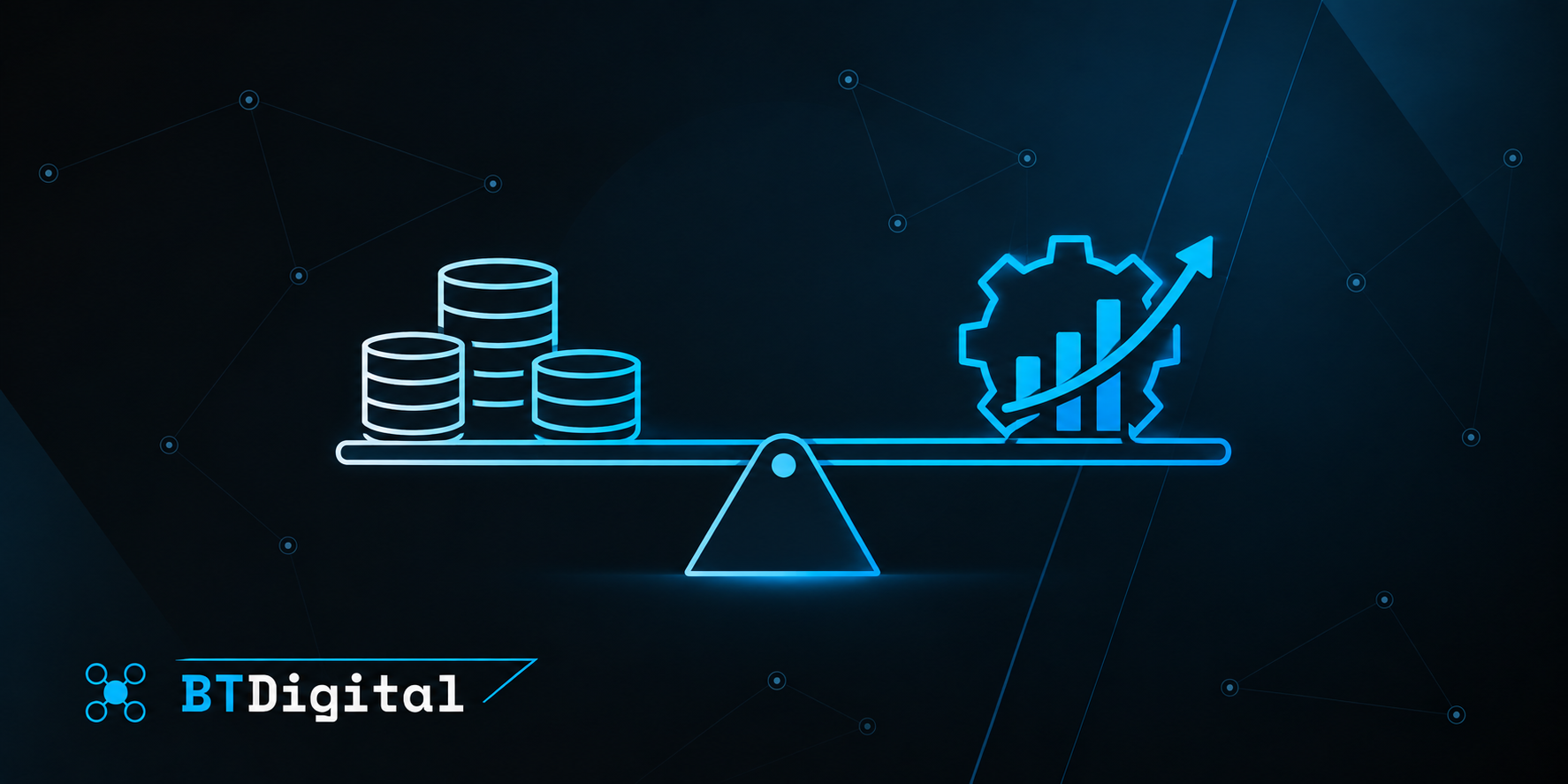
The return on custom software depends on the problem it solves, the amount of manual work it eliminates, the errors it prevents, its ability to support growth and whether it enables opportunities that were previously unavailable.
The more useful question is therefore not necessarily how much custom software costs, but how much the problem it solves is currently costing the business.
What does return on investment mean for software?
When discussing ROI, it is easy to think only about additional revenue.
Business software, however, can create value in several different ways.
It may reduce the time required for repetitive tasks. It can eliminate manual data transfer between systems, reduce errors, simplify customer service or allow the same team to handle a larger workload.
In other cases, software may become part of a revenue-generating service itself.
The return on software investment therefore does not always appear as a single number.
One of the easiest factors to measure: working time
The cost of repetitive manual processes is often less visible than the price of a development project.
Consider an administrative process that requires two hours every working day. Over a month, this can represent dozens of working hours. Over a year, it becomes a significant amount of capacity.
If a well-designed system automates most of that work, the time saved can be quantified.
A simplified calculation could be:
hours saved × total cost per working hour = estimated operational saving
Other factors can then be added, including reduced error correction, faster processing or software subscriptions that are no longer required.
This allows custom development to be evaluated not simply as an IT expense, but as an investment intended to reduce an existing operational cost.
Manual processes also have hidden costs
Not every loss appears directly on a cost report.
If an employee regularly copies information from one system to another, the cost is not limited to working time.
Data can be entered incorrectly. A task can be missed. Information can arrive too late. A customer may have to wait longer. Management information may already be outdated by the time a report is completed.
These effects are more difficult to quantify precisely, but they can still influence business performance.
When evaluating the return on a software project, it is therefore useful to consider the total cost of the current process rather than working hours alone.
When can custom development become justified?
Custom software should generally not be developed simply because it is technically possible.
It becomes commercially relevant when a problem is frequent, costly or important enough for solving it to create measurable value.
This may be the case when the same process is performed many times each day, several employees spend significant time on manual administration, data constantly needs to be copied between systems or the limitations of existing software interfere with operations.
Frequency is particularly important.
Automating a ten-minute task that occurs several times a year is unlikely to generate significant value. Saving a few seconds on an operation performed hundreds of times every day can be a very different calculation.
Growth can change the calculation
A manual process can work perfectly well at a small scale.
With ten orders, twenty customers or a handful of projects, even a spreadsheet may be sufficient.
Problems often emerge when the business begins to grow.
If twice as many customers create twice as much administration, growth may require continuously increasing human capacity.
Appropriate software can partially change this relationship.
When a process is automated or significantly accelerated, a higher number of customers, orders or transactions may be handled without increasing administrative capacity at the same rate.
The return can therefore come not only from reducing current costs, but also from avoiding future costs.
When the compromises of existing software become expensive
Not every custom development project is intended to automate a manual process.
A business may already use several existing systems that do not work particularly well together.
This can lead to workarounds: spreadsheets, manual exports and imports, separate records or internal procedures that exist only because the software cannot adequately support the actual workflow.
Custom development does not necessarily mean replacing everything with a completely new system.
It could mean an integration, a central administration interface, a specialised module or a backend that connects existing applications.
In this situation, the return comes from making technology fit the process more effectively.
ROI can also come from additional revenue
The value of custom software does not have to come exclusively from cost reduction.
A new customer portal may make a service easier to use. A self-service platform may create a new sales channel. An internal system may enable the introduction of a new service. An automated process may provide faster customer service.
For some businesses, the software itself may become part of the product or service.
In these situations, the calculation should consider not only how much the system can save, but also what additional revenue or business opportunities it can enable.
When is custom development unlikely to pay off?
Custom development is not the right solution to every problem.
If a process occurs rarely, requires little time or is already adequately covered by existing software, developing a custom system may be difficult to justify.
The same applies when the underlying business process itself is still changing significantly.
Building an unstable process into software can result in substantial modifications being required shortly afterwards.
In some cases, a simple SaaS solution, an integration or a smaller automation may therefore provide a better return than a completely custom system.
How can ROI be estimated before development begins?
Before starting development, several basic questions can be quantified:
- How often does the process occur each week or month?
- How much working time does it currently require?
- How many people are involved?
- How often do errors occur, and what does correcting them cost?
- Which software or operational costs could be eliminated?
- How will the cost of the process change as the business grows?
- Could the system create additional revenue or capacity?
These figures can form the basis of a simple ROI estimate.
For example, if a system is expected to save HUF 8 million in labour and operational costs each year while costing HUF 12 million to implement, its simple cost-based payback period would be approximately 18 months.
A real business case may naturally be more complex. Maintenance, future development, implementation costs and whether the estimated savings can actually be realised should also be considered.
The important point is that the business value of custom development can be evaluated before the project begins.
More features do not necessarily mean better ROI
When designing custom software, it is easy to keep adding functionality to the original idea.
Every additional feature, however, requires development time, testing and future maintenance.
From an ROI perspective, it can therefore be more effective to focus first on the functionality that solves the most significant business problem.
A smaller initial version may already eliminate the most time-consuming manual process or resolve the most important operational bottleneck.
Real-world usage can then help determine which additional features are valuable enough to justify further investment.
This approach can reduce development risk while allowing the investment to begin generating value sooner.
The BT Digital approach
BT Digital does not treat custom software development as an objective in itself. Development makes sense when it provides a proportionate and sustainable solution to a specific business problem.
Before development begins, it is therefore useful to understand the existing processes, manual work, current systems and the areas where technology can create measurable value. The appropriate solution does not necessarily have to be an entirely new application: it may be a custom business system, an extension of an existing solution, a backend, an API integration or an automation.
The objective is to build software whose value is measured not by the number of features it contains, but by its ability to simplify operations, reduce unnecessary work, support growth or create new business opportunities.