An SLA does not mean every incident is fixed within eight hours
A Service Level Agreement defines how support and operations are provided. It may cover support hours, priorities, first response, communication, availability measurement and the incident process.
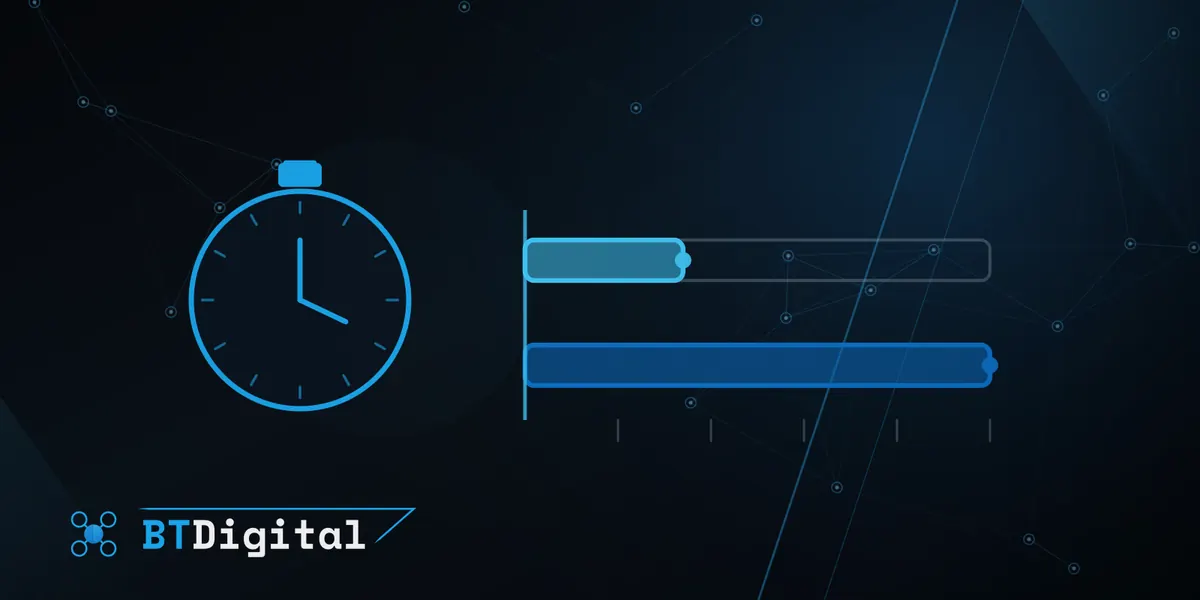
A common misunderstanding is that an “8-hour response time” guarantees final resolution within eight hours. It usually means that the provider will acknowledge, assess and begin handling the incident within that period under the agreed conditions.
Core terms
- First response time: time between a valid report and a meaningful human response.
- Diagnostic time: time used to identify the cause or affected area.
- Restoration time: time until essential business operation is restored, potentially through a temporary workaround.
- Resolution time: time until the root problem is permanently corrected.
- Availability: the proportion of the measurement period during which the defined service was usable.
Availability measurement must define the monitored component, measurement location, maintenance exclusions, third-party dependencies and reporting method.
What do the nines mean?
For a 30-day month of 43,200 minutes, the theoretical maximum downtime is approximately:
| Availability target | Maximum downtime / 30 days |
|---|---|
| 99% | 7 hours 12 minutes |
| 99.5% | 3 hours 36 minutes |
| 99.9% | 43 minutes 12 seconds |
| 99.95% | 21 minutes 36 seconds |
| 99.99% | 4 minutes 19 seconds |
Higher targets require stronger redundancy, monitoring, automation, on-call capability and infrastructure. They are engineering and organisational commitments, not merely contract wording.
Typical priorities
- P1 Critical: complete outage or critical business function unavailable without a workaround.
- P2 High: major function affected, but partial operation or a workaround exists.
- P3 Normal: limited defect that does not stop the core workflow.
- P4 Low / enhancement: convenience change, design adjustment or new feature; generally a backlog item rather than an incident.
Priority should reflect users affected, revenue impact, workarounds, data-loss or security risk and whether the impact grows over time.
Business hours or 24/7?
“24-hour response” may mean 24 business hours, the next business day or 24 calendar hours. An SLA must state support days, time zone, holidays, reporting channel, when the clock starts and which priorities receive out-of-hours handling.
True 24/7 support requires more than a phone number. It needs an on-call rotation, alerts, documentation, access and decision authority.
What should a good SLA contain?
Supported systems, reporting channels, support hours, priority definitions, first response targets, critical-incident communication, monitoring responsibilities, maintenance rules, exclusions, reporting, defect boundaries and escalation paths.
The BT Digital approach
Support should match business criticality. A brochure website does not need expensive 24/7 coverage, while a revenue-generating order system should not rely on occasional email support.
An SLA creates value when all parties share the same definitions and the technical operating model can actually support the commitment.