When Does Custom Software Make More Sense Than SaaS?
When introducing a new digital solution, one of the first questions is often whether to choose existing software or develop a custom system.
CRM, project management, invoicing, customer management, inventory and internal administration are just some of the areas where ready-made subscription-based applications are available. These are commonly referred to as SaaS, or Software as a Service, solutions.
In other situations, however, a business may rely on processes that are too specific to fit comfortably into an off-the-shelf product. This is where custom software development may become an option.
There is no universal answer that applies to every business. The appropriate approach depends primarily on business processes, required flexibility, costs and long-term objectives.
What is SaaS?
SaaS is a software delivery model in which access to an existing application is typically provided through a subscription.
The provider is responsible for the software itself, its infrastructure, updates and much of its technical operation. Users generally access the system through a web browser or application.
One of the main advantages of SaaS is that an existing solution can usually be introduced relatively quickly.
If a business needs a standard project management system, for example, developing a custom application may not be necessary. An existing service may provide the required functionality with a significantly shorter implementation time.
When can SaaS be a good choice?
Ready-made software can be particularly practical when a business process does not differ significantly from similar processes in other organisations.
For general task management, calendars, email or basic CRM functionality, for example, many businesses require broadly similar features.
SaaS can offer fast implementation, a predictable subscription model and the advantage of having much of the technical infrastructure managed by the provider.
These services are also often continuously developed, allowing new functionality and security updates to become available without a separate development project.
Where can SaaS become limiting?
An off-the-shelf application is designed to serve many different customers. As a result, it may not match every company's individual way of working.
A business may need to adapt its processes to the software, certain functionality may be unavailable, or several separate services may have to be used together.
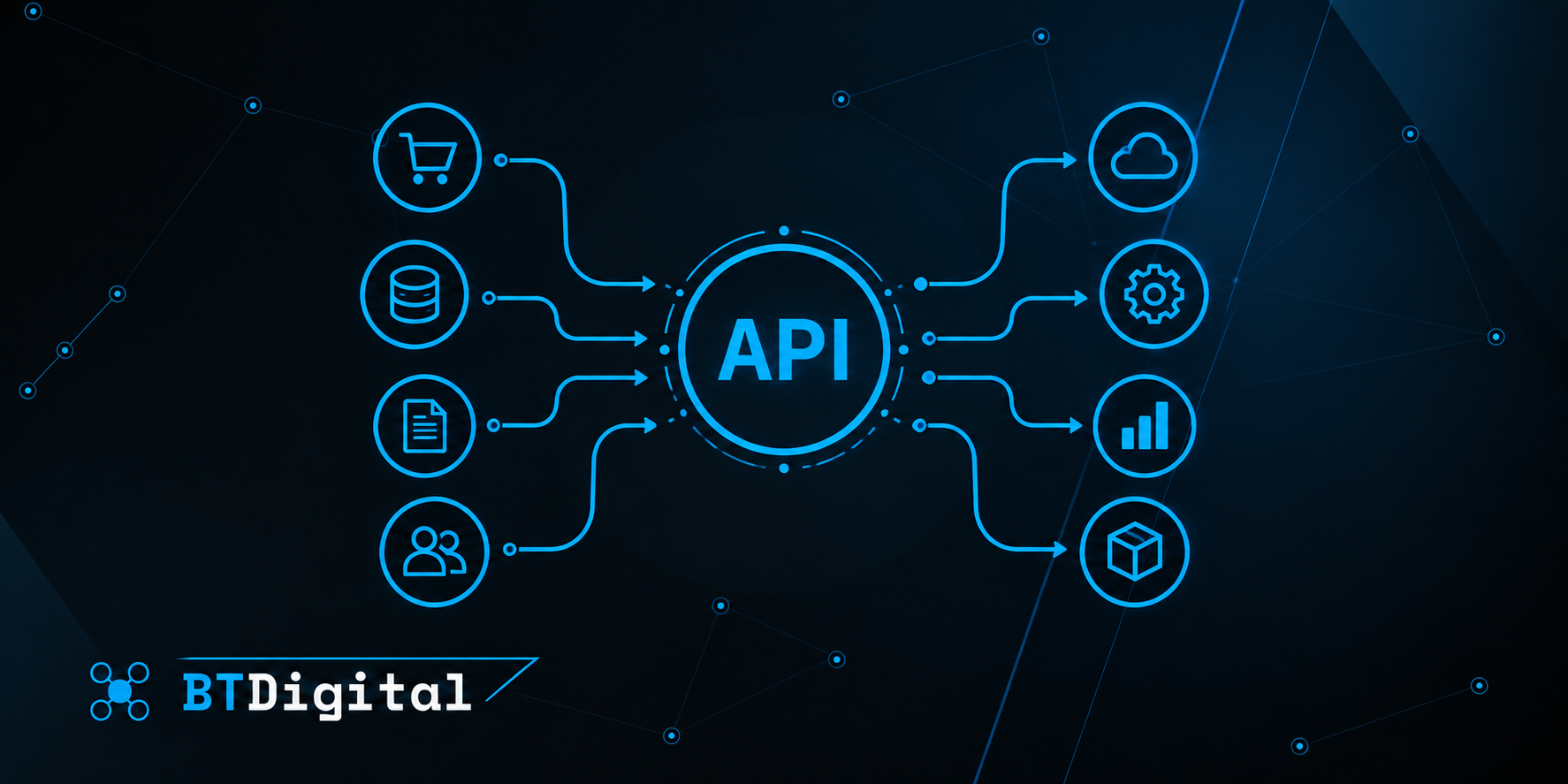
Integration is another important consideration. If a SaaS application needs to communicate with an ERP, e-commerce platform or custom internal system, suitable APIs or other integration options may be required.
The cost structure can also change as the business grows. A service priced per user or according to usage may be economical initially but can represent a different level of cost as user numbers or data volumes increase.
What is custom software?
Custom software is developed around the specific requirements and processes of a particular business.
Instead of adapting the business to the features of an existing product, functionality can be designed around the underlying business problem.
The result might be a complete business application, an internal administration platform, a customer portal, a solution supporting a specialised workflow or a backend system connecting several existing services.
One of the main advantages of custom development is this flexibility.
However, it also comes with greater responsibility. Designing, developing, testing, operating and continuously improving the software requires appropriate technical resources.
When can custom software make sense?
Custom development becomes particularly relevant when software needs to support a process that is important to the business but cannot be handled effectively by existing products.
This may occur when several systems need to participate in a specialised workflow, custom permission structures are required, specific business logic needs to be implemented, or existing tools leave significant amounts of manual work in the process.
Another consideration is whether the software itself forms part of the company's service or competitive differentiation.
In such cases, custom functionality is not simply an IT decision. It can become part of the underlying business model.
Cost: subscription or development investment?
The costs of the two approaches cannot always be compared based on their initial price alone.
A SaaS solution typically has a relatively low initial cost followed by monthly or annual subscription fees. Pricing may depend on the number of users, the selected plan or the amount of usage.
Custom software generally requires a larger initial investment. Operating, maintaining and extending the system also creates ongoing costs.
A meaningful comparison should therefore consider the complete lifecycle.
The question is not only how much the system costs during the first year, but also how much manual work it eliminates, which additional systems are required alongside it, how well it supports growth and what it costs to adapt to changing business requirements.
What about data and control?
With SaaS, a significant part of the system is controlled by the provider.
The provider determines which features are available, how the product evolves, which integrations are supported and under what technical conditions the service can be used.
This is not necessarily a disadvantage. In many cases, having the provider handle these responsibilities is one of the main reasons to use SaaS.
From a business perspective, however, it is worth considering data export options, integrations, access control and what would happen if the business decided to change providers.
A custom system can provide greater control over functionality and architecture, but that control also comes with greater technical responsibility.
It does not always have to be one or the other
SaaS and custom development are not necessarily mutually exclusive.
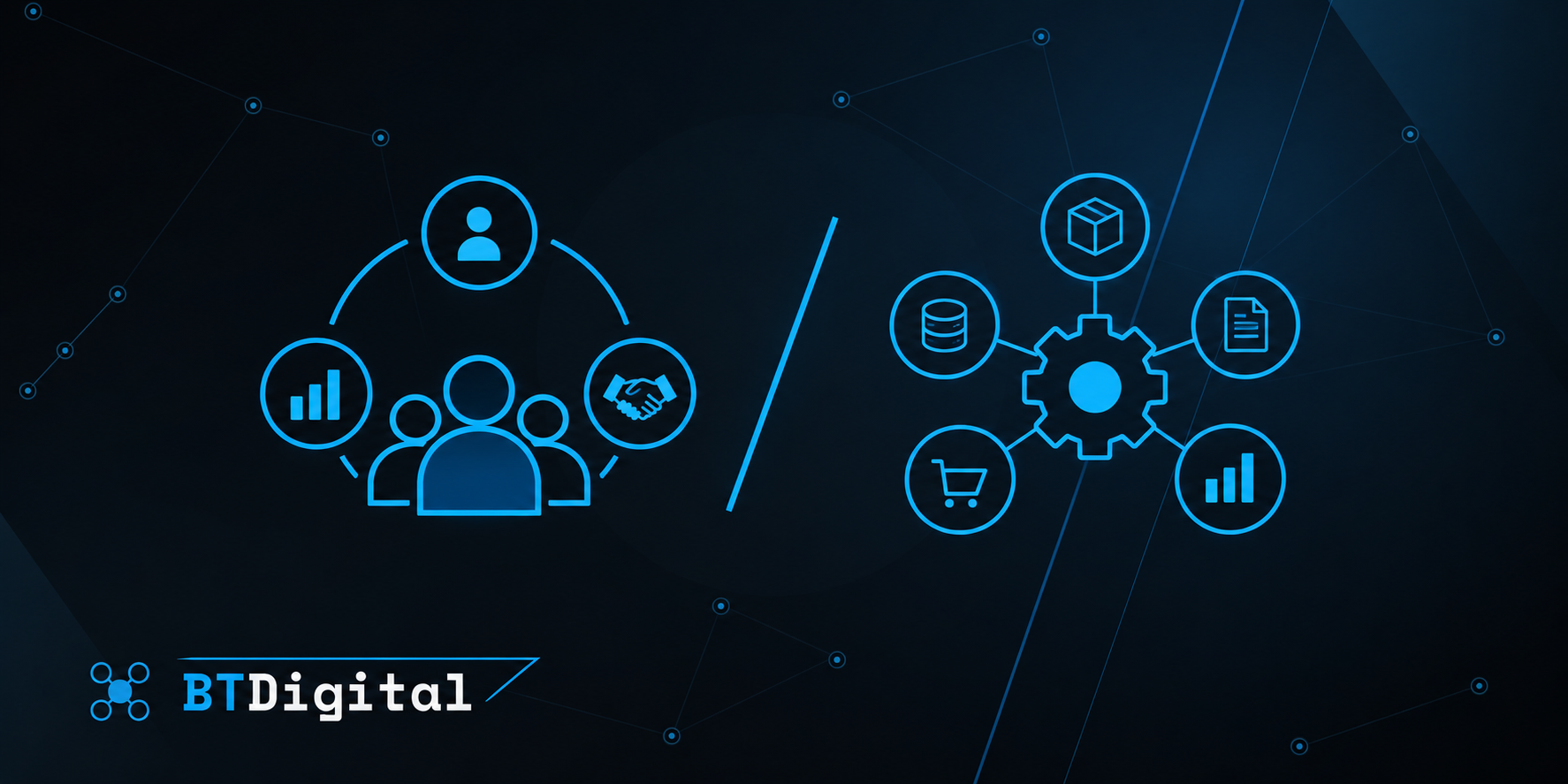
A business can use an existing CRM, invoicing software, email service and other SaaS applications while relying on custom software for the processes that are genuinely unique.
For example:
SaaS CRM + invoicing platform + custom customer portal + custom integrations
With this model, there is no need to rebuild functionality that is already adequately provided by existing services. Custom development can focus on the areas where specific business requirements actually exist.
For many businesses, the most useful question is therefore not simply “SaaS or custom software?”
It is which parts should use existing solutions and which parts justify custom development?
What should be considered before making a decision?
Before choosing the technology, it is useful to examine the business process itself.
Can an existing product solve most of the problem? How specialised is the process? Does the system need to integrate with other applications? How frequently do the requirements change? How many people will use it? How much control is required over data and functionality?
It is equally important to consider how strategically important the functionality is to the business.
For a standard supporting process, there may be little business reason to recreate functionality that existing products already provide effectively.
If the process is unique, business-critical or directly contributes to differentiation, however, the value of custom development may be significantly greater.
The BT Digital approach
BT Digital's approach does not begin with the assumption that every problem requires custom software. The first step is to examine how well existing SaaS solutions can cover the business requirement, where their limitations appear and which processes genuinely justify custom development.
Depending on the situation, the appropriate solution may be a fully custom business application, further development of an existing system, integration of SaaS services or a combination of these approaches. BT Digital can support such solutions through the development of custom web and business applications, backends, APIs and system integrations.
The objective is not to replace an existing service when it already performs its role effectively. Custom development can create value where adaptation to specific business processes, communication between systems or specialised functionality makes it necessary.